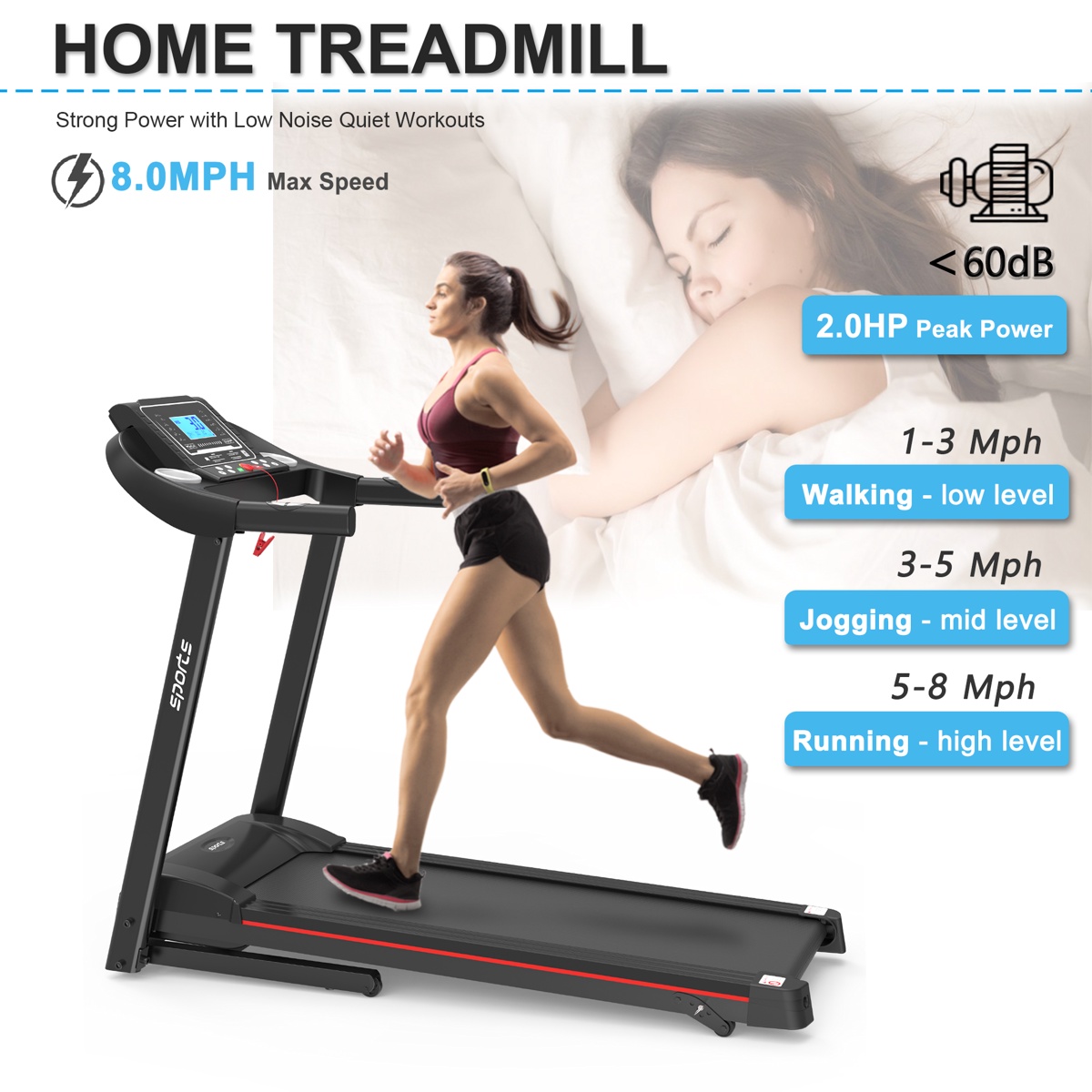

Photos from current listings. Actual item, color, and included accessories may vary.
Treadmill Incline Workout Buying Guide
A treadmill incline workout means walking or running on a motorized belt whose deck tilts upward to raise intensity without added speed, primarily relying on motor power and frame rigidity rather than cushioning gimmicks. The core trade-off is between foldable, low-profile decks with modest incline range and heavier fixed-frame units with higher continuous horsepower. Decision rule: buy a foldable unit only if the incline motor is rated for the full deck load and the frame uses welded steel, not bolted aluminum; otherwise choose a fixed-frame treadmill with at least 10% incline and a 2.5 CHP motor.


At a glance
- Category
- Cardio Machines
- Data updated
- Nov 17, 2026
Current offers
Highlights
- Incline is driven by a separate linear actuator motor; budget foldables often use plastic gears that strip under repeated 10%+ settings.
- Continuous horsepower (CHP) governs sustained incline walking; anything under 2.0 CHP overheats on 30-minute 8%+ sessions.
- Deck thickness of 3/4 inch or 1 inch with 6+ cushioning elastomers prevents joint stress at incline, where gravity load shifts to the forefoot.
- Foldable frames with a single hinge pin and 250 lb capacity rely on locking latches; welded steel frames with dual hinges support 300 lb+ users.
Best use cases
- Best fit: apartment walker under 200 lb needing 0–10% incline and fold-flat storage — pick a 2.0–2.5 CHP foldable with a locking deck latch.
- Best fit: daily incline runner over 220 lb — choose a fixed-frame treadmill with 3.0+ CHP, 1-inch deck, and 15% incline motor rated for continuous duty.
- Wrong fit: buying a foldable rated 250 lb for a 240 lb user who plans 12% incline intervals — the hinge and actuator wear out first; step up to a welded frame.
- Wrong fit: expecting a 5-inch LCD budget unit to run Zwift or iFit incline programs — those require Bluetooth FTMS and a tablet holder; skip units without FTMS.
Buying tips
- Match motor to user weight plus incline: add 0.5 CHP for every 50 lb over 180 lb and 0.3 CHP for sustained incline above 8%.
- Check deck dimensions: incline walking needs at least 20 x 55 inches; runners over 6 ft need 22 x 60 inches to avoid heel drift off the belt.
- Confirm incline motor type — look for a linear actuator with metal gears, not a worm gear in nylon; metal gears survive 10,000+ incline cycles.
- Verify Bluetooth FTMS or app compatibility if you want auto-incline workouts; plain Bluetooth audio (as on the Fitshow unit) does not control incline.
Specs
| Motor Power | 2.0–3.5 CHP continuous |
|---|---|
| Incline Range | 0–10% foldable / 0–15% fixed |
| Deck Size | 20x55 in to 22x60 in |
| Weight Capacity | 250–350 lb structural limit |
Related searches
What to check before buying
- Measure floor space with the deck folded and unfolded; foldables still need 6–8 ft of clearance behind for the belt when inclined.
- Check ceiling height: at 15% incline, a 6 ft user's head rises roughly 4–6 inches above flat walking height — allow 12 inches above your standing height.
- Confirm the unit's plug standard and circuit: 2.5+ CHP treadmills draw 15 amps and need a dedicated grounded outlet, not a shared power strip.
- Verify user weight against the stated capacity minus 20% margin; a 250 lb rating is a structural limit, not a comfortable daily load for a 240 lb user.
FAQ
Data sources: eBay / Amazon listings and product attribute feeds Data updated Nov 17, 2026.
Some links on this page are affiliate links. If you buy after clicking one, we may earn a commission at no extra cost to you. This does not change which products appear here or their order. Affiliate disclosure.