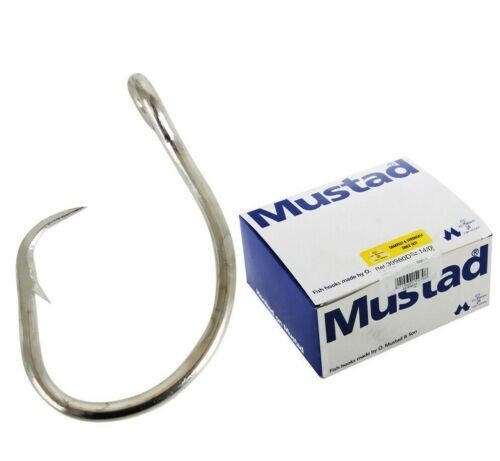

Photos from current listings. Actual item, color, and included accessories may vary.
Mustad Circle Hook Buying Guide
Mustad circle hooks are forged, chemically sharpened hooks designed to rotate and lodge in the corner of a fish's mouth, reducing deep hooking and gut hooks. The key trade-off is wire gauge versus finesse: heavier 2X-strong forged wire survives big fish and braid, but can be too stiff for shy, pressured fish. Choose a true circle-hook geometry (offset or non-offset per local rules) with a forged, Duratin or Coastal Black finish; skip generic 'circle-style' hooks with a straight eye and wide gap, which defeat the self-setting action.


At a glance
- Category
- Fishing Hooks, Lures & Baits
- Data updated
- Nov 18, 2026
Current offers
Highlights
- Mustad's 39960-DT is a forged 2X-strong circle hook with Duratin (tin) coating — ideal for saltwater corrosion resistance and heavy braid pressure.
- Non-offset (inline) circle hooks are legally required for many billfish and reef fisheries; offset models hook more aggressively but are banned in some regions.
- Duratin finish offers moderate saltwater protection; Coastal Black or stainless variants are better for repeated salt exposure and toothy species.
- Circle hooks must be snelled or tied with a straight eye and left exposed — covering the point with bait or using a trailer hook cancels the rotating geometry.
Best use cases
- Best for bottom fishing for grouper, snapper, and cod with heavy braid: pick a 2X-strong forged circle in Duratin, sized so the gap clears the bait.
- Best for catch-and-release billfish or reef rules: choose a non-offset (inline) circle hook — offset models are banned in many tournament and marine-protected areas.
- Wrong fit for freshwater finesse or small trout: a 2X-heavy forged circle is too stiff and heavy; use a light-wire octopus or mosquito hook instead.
- Wrong fit for topwater lures or soft-plastic Texas rigs: circle hooks need a bait-and-wait presentation; use EWG or treble hooks for active lure fishing.
Buying tips
- Size the hook gap to roughly half the bait width: a gap too small buries the point, too large exposes the shank and reduces hookup ratio.
- Match wire strength to line and target: 2X-strong forged wire for braid and fish over 10 lb; standard wire for light mono and pressured fish.
- Choose non-offset (inline) circle hooks where regulations require them; offset hooks improve hookups but are illegal in some billfish and reef fisheries.
- Duratin is fine for occasional saltwater; upgrade to Coastal Black or stainless when fishing repeatedly in salt or for toothy species.
Specs
| Hook Geometry | Circle: non-offset vs offset |
|---|---|
| Wire Strength | Standard vs 2X-strong forged |
| Finish Options | Duratin / Coastal Black / Stainless |
| Eye Configuration | Straight eye (snell-ready) |
Related searches
What to check before buying
- Confirm local regulations: many fisheries require non-offset (inline) circle hooks — check the eye-to-point alignment before buying.
- Measure your bait: hook gap should be about half the bait's widest dimension for proper rotation and corner hooksets.
- Match hook size to target species: size 1/0–3/0 for panfish and bass, 4/0–6/0 for snapper and striped bass, 7/0+ for grouper and tarpon.
- Check your rod/reel drag and line class: 2X-strong forged hooks pair with 20–50 lb braid; light mono needs standard wire.
FAQ
Data sources: eBay / Amazon listings and product attribute feeds Data updated Nov 18, 2026.
Some links on this page are affiliate links. If you buy after clicking one, we may earn a commission at no extra cost to you. This does not change which products appear here or their order. Affiliate disclosure.