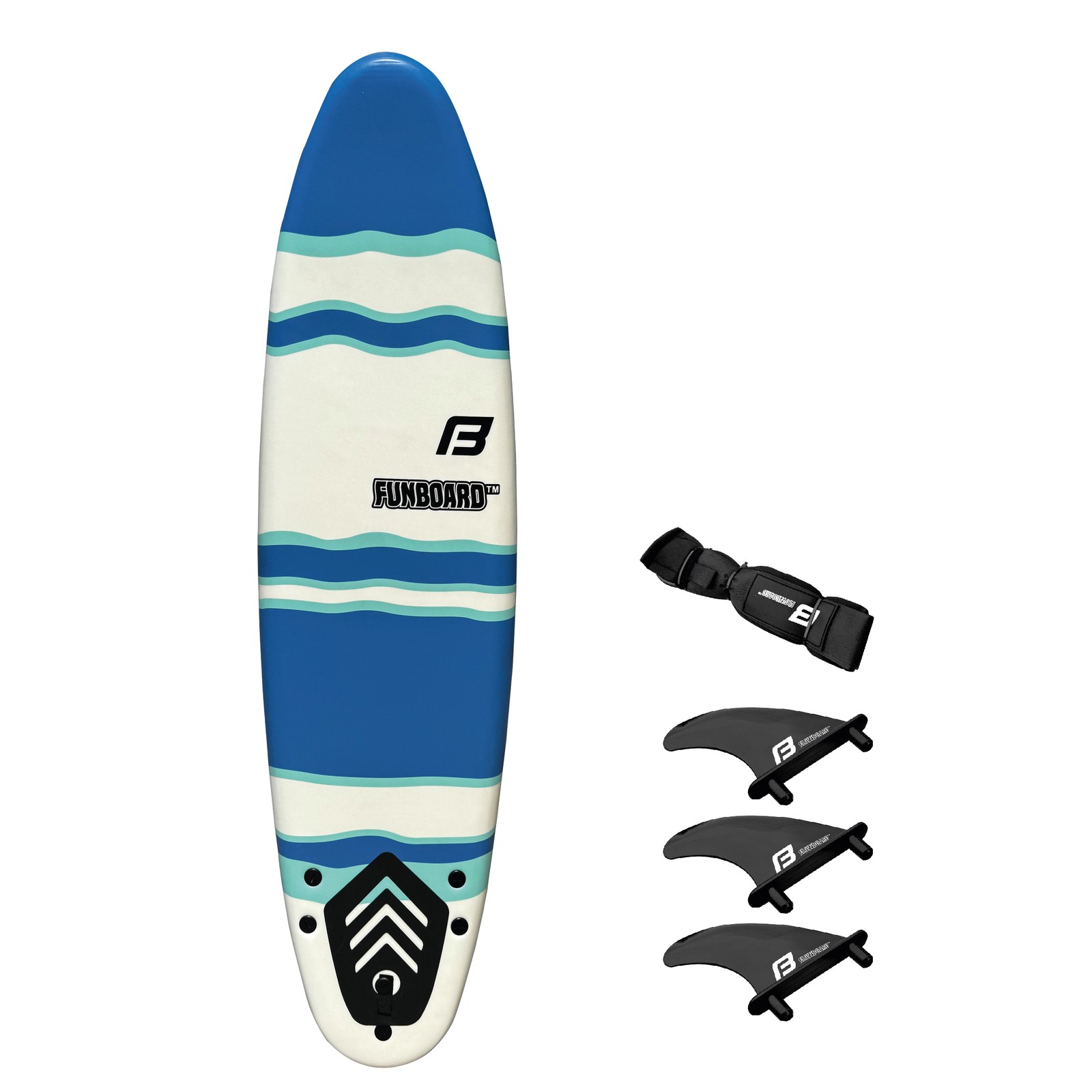

Photos from current listings. Actual item, color, and included accessories may vary.
Foam Surfboard Buying Guide
Foam surfboards are soft-top boards built around a rigid core with a dense foam deck and slick or textured bottom, designed for safety, buoyancy, and paddle-friendly durability. The primary trade-off is soft-top convenience versus long-term structural integrity: entry-level boards use a single wood stringer and low-density EPS, while durable options use dual stringers, higher-density foam, and reinforced fin boxes. The decision rule is simple: buy a dual-stringer or composite-core foam board if you plan to surf regularly or progress beyond whitewater; choose a single-stringer soft-top only for absolute beginners or casual loaner use.


At a glance
- Category
- Surfboards
- Data updated
- Nov 16, 2026
Current offers
Highlights
- Core construction: EPS foam core with 1-2 wood stringers; dual stringers resist buckling and snap-back far better than single-stringer boards under repeated paddling and pop-ups.
- Deck skin density: soft-top foam decks range from low-density polyethylene (light, dents quickly) to high-density cross-linked PE or EVA (heavier, resists pressure dings and UV degradation).
- Fin system: molded-in thruster fins are nearly indestructible for beginners; removable FCS-compatible or Futures-compatible fin boxes allow tuning but require reinforcement plates to avoid pull-out.
- Bottom contour: slick HDPE bottom slides faster but is prone to peeling at rails; textured or mesh-bottom foam boards trade a little speed for better durability and grip.
Best use cases
- Best fit: first-time surfers and family loaner boards in waist-to-chest-high whitewater — pick a single-stringer soft-top with molded fins and a leash plug rated for the board's length.
- Best fit: progressing beginners surfing 2-3 times per week — step up to a dual-stringer foam board with high-density deck and reinforced removable fin boxes for longevity.
- Wrong fit: experienced surfers seeking performance turns or overhead waves — foam boards flex and lack rail bite; choose a fiberglass or epoxy hardboard instead.
- Wrong fit: storing on a hot car roof or black sand beach all day — low-grade PE foam delaminates and warps; only high-density EVA/PE decks with UV inhibitors survive sustained heat exposure.
Buying tips
- Match length to weight and skill: beginners need 8'0"–9'0" for 150–200 lb riders; 7'0"–8'0" suits 120–160 lb; sub-7'0" foam boards are for lightweight or intermediate riders only.
- Check stringer count and placement: dual stringers should run parallel from nose to tail, spaced roughly 2–3 inches apart; single center stringers are entry-tier and prone to snapping at the midpoint.
- Verify fin box reinforcement: removable fin boxes should have a visible plastic or composite plate under the deck skin; molded-in fins are safer for beginners but limit tuning.
- Confirm leash plug and rail construction: a through-box leash plug anchored to the stringer is stronger than a surface-mounted plug; wrapped rails with seamless deck-to-bottom bonding resist water intrusion.
Specs
| Core & Stringer | EPS foam / 1-2 wood stringers |
|---|---|
| Deck Material | PE or EVA foam (low/high density) |
| Fin System | Molded-in or FCS/Futures boxes |
| Bottom Skin | Slick HDPE or textured mesh |
Related searches
What to check before buying
- Measure your storage and transport: foam boards 8'0"–9'0" need a vehicle with roof racks or a truck bed; confirm board length fits your rack spread and garage ceiling.
- Check your weight against board volume: foam boards typically run 40–60 liters for 7'0", 60–80 liters for 8'0", and 80–100 liters for 9'0"; pick volume roughly equal to your weight in kilograms times 1.0–1.3 for beginner stability.
- Confirm fin compatibility: if the board has removable boxes, verify they accept standard FCS or Futures fins; molded-fin boards need no extras but cannot be swapped.
- Test climate and water exposure: high-UV climates and tropical heat demand UV-inhibited EVA or PE decks; cold-water surfing requires a leash and wax rated for water temperature below 60°F.
FAQ
Data sources: eBay / Amazon listings and product attribute feeds Data updated Nov 16, 2026.
Some links on this page are affiliate links. If you buy after clicking one, we may earn a commission at no extra cost to you. This does not change which products appear here or their order. Affiliate disclosure.