Choosing gear for running apparel & recovery often comes down to one question: do you want a general-purpose roller, or a shaped tool for more targeted work? The Rollga foam roller takes the second approach, with grooves and bumps designed around back, neck, and muscle-release use. That makes it more specialized than a simple cylinder, so the best choice depends on how deliberately you want to target recovery areas.
Quick verdict
Rollga is a sensible fit for runners who want a single recovery tool with several contact zones rather than a plain rolling surface. Its grooves are designed to let the spine, bones, and tendons sit between the raised sections, while the bumps focus on specific muscles. At USD 39.88, the appeal is the shaped design and the range of ways to position it-not a promise of a particular recovery result.
Who it suits
Rollga makes the most sense for someone whose routine includes targeted work on muscles, back tension, or neck tension. The rounded ends also allow wall-based use, which gives you another way to control pressure and reach specific trigger points. That flexibility can be useful when floor rolling is not the most comfortable setup or when you want to work on one area at a time.
It is also a straightforward match for runners looking for dedicated runner recovery gear rather than clothing or wearable support. The blue roller is designed for indoor and outdoor use, although its main role is clearly muscle-release work.
What stands out from the design
Rollga - The Better Foam Roller for Back Pain, Flexibility, & Muscle Recovery
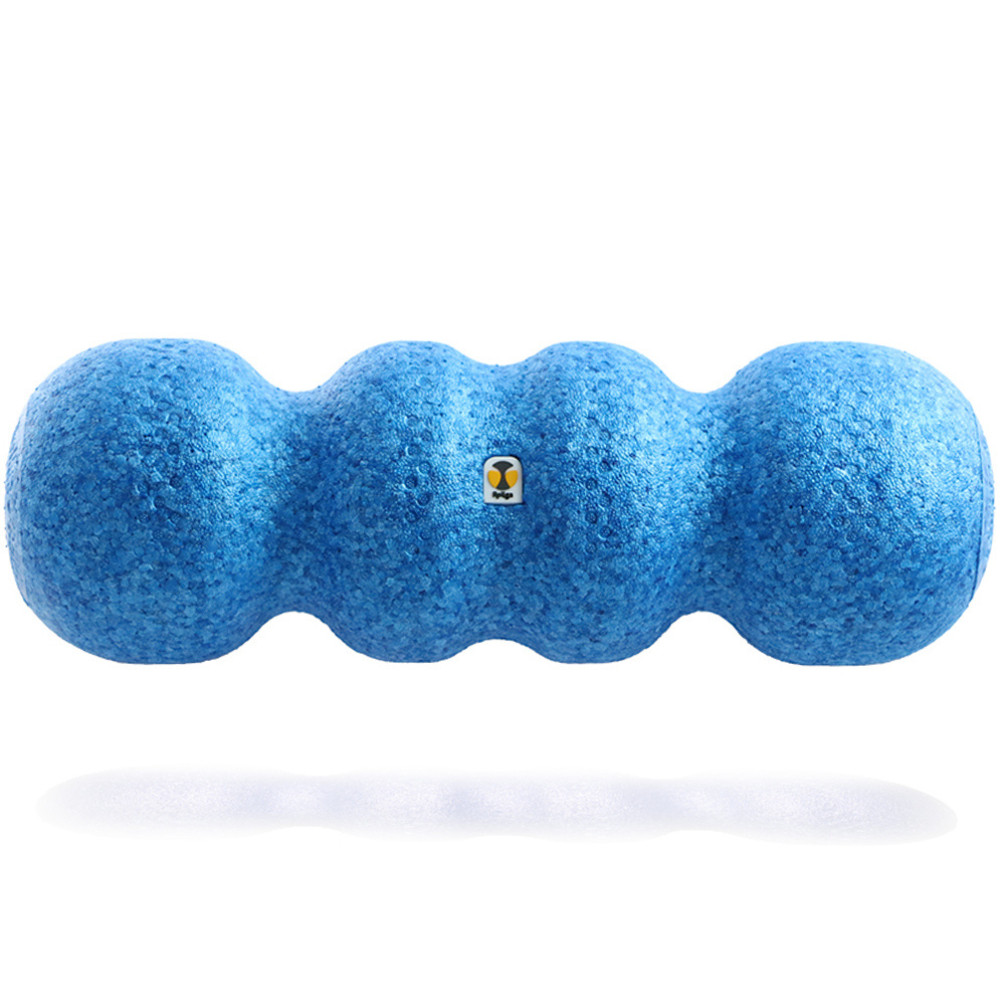
The defining feature is the combination of a central spinal channel, grooves, and raised bumps. The channel is shaped to cradle the spine, while the grooves are engineered around the shape of a thumb and the bumps around palms and elbows. In practical terms, Rollga is built around several types of contact instead of one continuous surface.
The rounded ends add a useful positioning detail. They are intended for use against a wall and for reaching specific trigger points with more control. That gives the roller a clear purpose for focused sessions, especially when broad rolling is not the goal.
Meaningful trade-offs
The shaped construction is also the main limitation: Rollga asks you to use its specific zones and positioning rather than treating it as a minimal, uniform roller. Its 18-inch length and 6-inch height and width are worth considering for storage and carrying, particularly if your recovery gear needs to fit into a small space. The 10-ounce weight is modest, but the overall dimensions still define how portable the roller feels.
Bottom line
Choose Rollga if the grooves, spinal channel, bumps, and wall-use design match the way you want to approach running recovery. Pass on the concept if those targeted features are not important to you or if the 18-inch form would be inconvenient to store. For its stated purpose, Rollga offers a clearly defined, multi-zone approach to foam rolling without asking you to choose separate tools for each contact style.