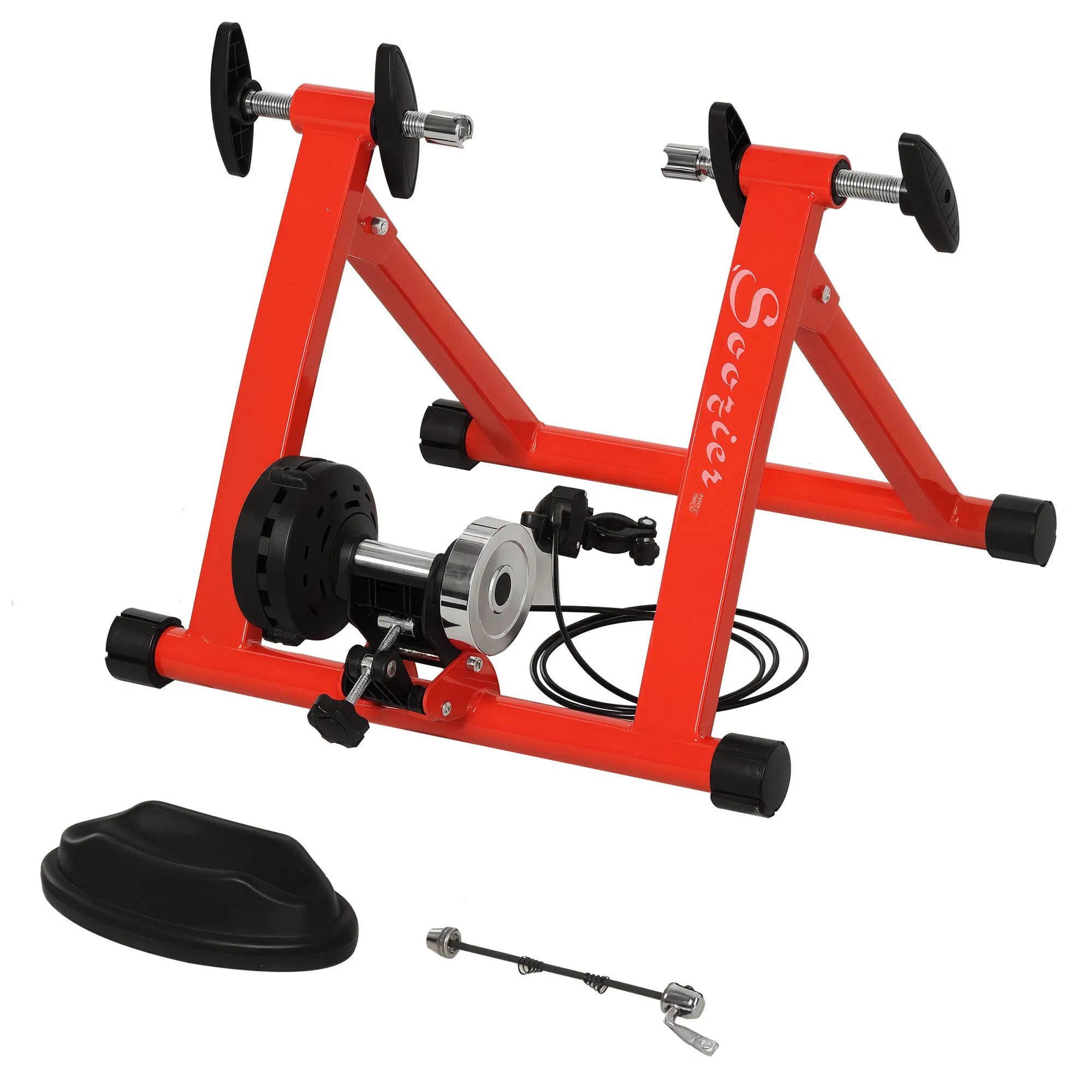

Photos from current listings. Actual item, color, and included accessories may vary.
Indoor Bike Trainer Stand Buying Guide
An indoor bike trainer stand converts a standard bicycle into a stationary trainer by holding the rear axle and applying resistance to the tire or drivetrain. The core trade-off is resistance architecture—magnetic, fluid, or direct-drive—which dictates noise, road feel, and maximum power ceiling. Choose a progressive fluid or direct-drive unit for structured training; choose a basic magnetic stand only for light spin or warm-up duty.


At a glance
- Category
- Cardio Machines
- Data updated
- Nov 16, 2026
Current offers
Highlights
- Magnetic trainers use a stepped or dial-adjusted magnet array with 5-8 resistance levels; power rises with speed but feel is not road-like and heat buildup caps long efforts.
- Fluid trainers use a sealed viscous chamber; resistance increases exponentially with wheel speed, giving the most realistic road feel and quietest operation under about 65 dB.
- Direct-drive trainers remove the rear wheel and connect the chain to a flywheel via cassette, delivering 5-15% power accuracy and support for 1,000W+ sprints.
- Axle compatibility splits into quick-release 130/135mm and thru-axle 142/148mm standards; most budget stands include a QR skewer but require a separate thru-axle adapter.
Best use cases
- Best fit: magnetic stand with 5+ levels for casual spin, warm-up, and low-budget winter riding—skip if you plan intervals above 300W.
- Best fit: fluid trainer for road-feel endurance rides and apartment use where noise matters—pick a sealed chamber unit, not an open fan design.
- Best fit: direct-drive smart trainer for Zwift-style training, ERG mode, and sprint work—skip wheel-on designs if you need ±2% power accuracy.
- Wrong fit: any wheel-on stand for 12mm thru-axle gravel or MTB frames without the matching adapter—buy the adapter at purchase or choose a direct-drive unit.
Buying tips
- Match the axle standard exactly: 130mm QR road, 135mm QR MTB, 142x12mm thru-axle, or 148x12mm Boost—each needs a specific cup or adapter.
- Wheel-on trainers require a smooth or trainer-specific tire; knobby MTB tires slip and shed rubber, so fit a slick or trainer tire.
- Resistance ceiling matters: magnetic units typically cap around 400-600W, fluid around 700-1,000W, and direct-drive 1,500W+; size to your sprint peak.
- Direct-drive buyers must budget for a cassette matching their drivetrain speed (8/9/10/11/12-speed) and freehub body type (Shimano HG, SRAM XD, Campagnolo).
Specs
| Resistance Type | Magnetic / Fluid / Direct-drive |
|---|---|
| Max Power | 400-600W mag / 700-1,000W fluid / 1,500W+ DD |
| Axle Compatibility | QR 130/135mm; TA 142/148mm w/ adapter |
| Noise Level | 65-75 dB wheel-on; ~55 dB direct-drive |
Related searches
What to check before buying
- Measure rear axle spacing and record the exact standard (QR 130/135mm or thru-axle 142/148mm) before selecting a stand or adapter.
- Confirm floor space: wheel-on stands need about 1.8m x 0.8m; direct-drive units need a stable, level surface and a mat for sweat and vibration.
- Check drivetrain compatibility for direct-drive: cassette speed count and freehub type must match your bike's groupset.
- Plan for noise and vibration: use a trainer mat and avoid upper-floor wooden joists if riding intervals or sprints.
FAQ
Data sources: eBay / Amazon listings and product attribute feeds Data updated Nov 16, 2026.
Some links on this page are affiliate links. If you buy after clicking one, we may earn a commission at no extra cost to you. This does not change which products appear here or their order. Affiliate disclosure.