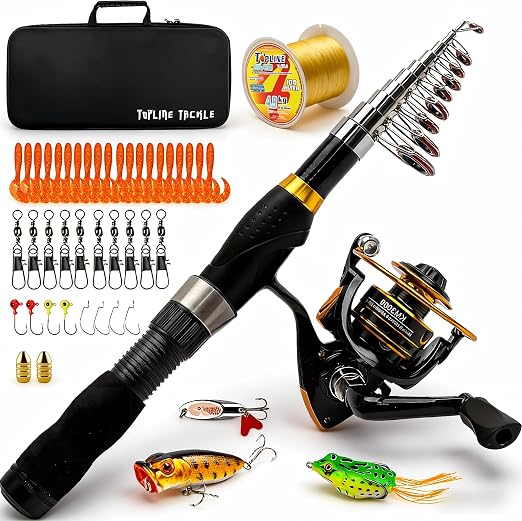

Photos from current listings. Actual item, color, and included accessories may vary.
Travel Fishing Pole Buying Guide
A travel fishing pole is a collapsible or multi-piece rod designed to pack small and set up fast, trading some sensitivity and lifting power for portability. The core trade-off is blank material and ferrule count: more joints and lower-grade fiberglass blunt feel and durability, while quality carbon blanks with reinforced ferrules preserve performance. Choose a carbon telescopic or 3–4 piece travel rod for real fishing trips; skip generic fiberglass combos only if you need light lure feel or repeated saltwater use.


At a glance
- Category
- Fishing Rods
- Data updated
- Nov 16, 2026
Current offers
Highlights
- Telescopic rods collapse to 14–24 in but use 6–10 ferrules; each joint adds weight and a dead spot, so carbon blanks with reinforced wraps outperform loose fiberglass sections.
- Multi-piece travel rods (3–4 sections) pack to 24–30 in and use fewer ferrules, giving near one-piece sensitivity and stronger spine for bigger fish.
- Blank material drives performance: IM6/IM7 carbon is light and sensitive; fiberglass is heavier but more forgiving and impact-resistant for rough travel.
- Reel seats and guides matter: stainless steel frames with ceramic inserts resist salt corrosion; graphite or aluminum reel seats hold reels securely under load.
Best use cases
- Best fit: backpacking or airline carry-on trips with carbon telescopic rod (collapsed under 20 in) and 1000–2500 size spinning reel for panfish and bass.
- Best fit: multi-species travel with 3–4 piece carbon rod in medium-light to medium power for freshwater lakes and light saltwater inshore.
- Wrong fit: targeting large saltwater species (tarpon, big stripers) with a telescopic rod—choose a 2-piece heavy-power rod or travel-specific heavy blank instead.
- Wrong fit: buying a fiberglass telescopic combo for daily lure fishing—sensitivity and guide quality are too low; use it only as a backup or kid’s pack rod.
Buying tips
- Match collapsed length to luggage: under 20 in fits daypacks; 24–30 in suits checked bags or car trunks—measure your pack before buying.
- Choose power by target: ultralight (1–6 lb line) for panfish/trout, medium-light (4–10 lb) for bass, medium (6–15 lb) for inshore salt—avoid medium-heavy telescopics.
- Check line rating and lure weight on the blank: a rod rated 1/8–3/8 oz won’t cast heavy lures; stay within printed lure and line ranges to avoid breakage.
- For saltwater, insist on stainless steel guides with ceramic inserts and a graphite reel seat; aluminum oxide guides and plastic seats corrode or crack.
Specs
| Blank Material | Carbon fiber vs fiberglass composite |
|---|---|
| Packed Length | 14–30 in (telescopic vs multi-piece) |
| Guide Type | Stainless+ceramic vs aluminum oxide |
| Rod Power | UL / ML / M / MH (line 1–20 lb) |
Related searches
What to check before buying
- Measure packed size against your backpack or carry-on: collapsed length + 2 in for reel clearance is your true travel footprint.
- Confirm reel seat size and foot compatibility: most travel rods fit 1000–4000 spinning reels; test your reel foot or buy a combo with matched reel.
- Check guide material for environment: freshwater okay with aluminum oxide; saltwater requires stainless frames with ceramic inserts.
- Verify blank power and line rating match your target fish and lure weights; rod rating is printed near the handle—read it before purchase.
FAQ
Data sources: eBay / Amazon listings and product attribute feeds Data updated Nov 16, 2026.
Some links on this page are affiliate links. If you buy after clicking one, we may earn a commission at no extra cost to you. This does not change which products appear here or their order. Affiliate disclosure.