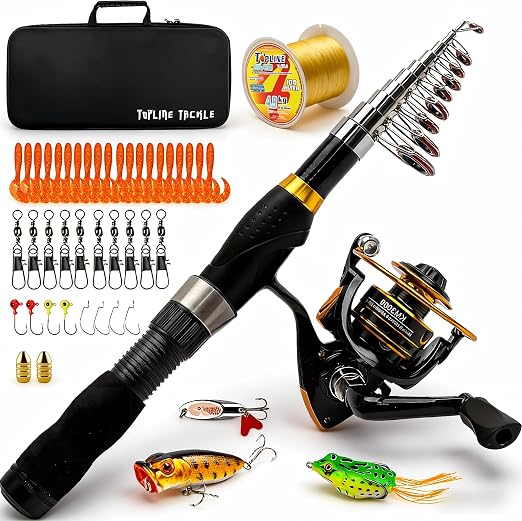

Photos from current listings. Actual item, color, and included accessories may vary.
Travel Rod Buying Guide
A travel rod is a multi-piece or telescopic fishing rod engineered to collapse into a backpack or airline-friendly tube without sacrificing fish-fighting integrity. The core trade-off is portability versus action fidelity: more joints and thinner wall sections improve packability but can soften backbone, dull sensitivity, and introduce ferrule failures. Choose a 3- or 4-piece rod with reinforced ferrules and a matching reel seat for serious travel angling; treat 5+ piece ultralight telescopics as emergency or backpacking compromises, not primary rods.


At a glance
- Category
- Fishing Rods
- Data updated
- Nov 16, 2026
Current offers
Highlights
- Piece count drives performance: 2-piece rods cast closest to one-piece feel, 3–4 piece travel rods balance pack length and action, 5+ piece telescopics trade backbone for extreme compactness.
- Ferrule construction is the durability bottleneck: reinforced wrapped or metal-sleeved ferrules resist loosening and cracking; bare friction-fit joints wear and slip under load.
- Blank material grade separates tiers: IM6/IM7 graphite offers a crisp, sensitive action, while generic composite or fiberglass blanks are heavier and more forgiving but less responsive.
- Reel seat and guide quality determine real-world longevity: graphite or machined-aluminum seats with stainless frames and hard inserts (SiC/Alconite) survive salt and repeated assembly better than plastic seats and wire guides.
Best use cases
- Airline and backpack travel with limited tube length: pick a 4-piece rod that packs under 24 inches and includes a hard travel tube; skip 2-piece rods that exceed carry-on limits.
- General freshwater travel (bass, trout, panfish): choose a 3-piece medium-light to medium rod with IM6 graphite and a fast action; skip ultralight telescopics that lack hook-setting power.
- Saltwater travel and surf-adjacent trips: select a 3- or 4-piece rod with stainless guides, saltwater-rated reel seat, and medium-heavy power; skip fiberglass telescopics with plastic seats.
- Emergency or ultralight backpacking where every ounce counts: a 5+ piece telescopic rod is acceptable if you accept reduced casting distance and fish-fighting backbone; skip it as your only rod for serious angling.
Buying tips
- Match packed length to your transport: 4-piece rods typically pack to 22–26 inches, 3-piece to 28–34 inches, and 2-piece to 44–52 inches — measure your airline tube or backpack before choosing.
- Choose power and action for your target species: medium-light fast for trout and panfish, medium fast for bass and walleye, medium-heavy for inshore saltwater; avoid extra-fast actions on multi-piece rods where ferrule flex can create flat spots.
- Prioritize ferrule and guide hardware at every price tier: reinforced wrapped ferrules, stainless guide frames, and hard inserts outlast cosmetic features like cork grade or paint finish.
- Confirm reel seat size compatibility: travel rods often use smaller seats — pair with reels in the 1000–3000 size class for freshwater and 3000–4000 for light saltwater, and check foot width against the seat.
Specs
| Piece Count | 2 / 3 / 4 / 5+ telescopic |
|---|---|
| Packed Length | 22–52 in by piece count |
| Blank Material | IM6/IM7 graphite vs composite |
| Ferrule Type | Reinforced wrapped vs friction-fit |
Related searches
What to check before buying
- Measure your maximum packed length: carry-on tube limits (typically 22–24 inches) and backpack internal length determine whether you need a 3-, 4-, or 5-piece rod.
- Match rod power and line rating to your target fish and reel: a medium rod pairs with 6–12 lb line and a 2500-size reel; a medium-heavy pairs with 10–20 lb line and a 3000–4000 reel.
- Verify guide and seat materials for your water: saltwater trips require stainless or corrosion-resistant guides and a non-plastic reel seat; freshwater tolerates standard stainless guides.
- Plan for ferrule maintenance and assembly: carry ferrule wax, seat joints firmly, and inspect for cracks before each trip — multi-piece rods demand more assembly care than one-piece rods.
FAQ
Data sources: eBay / Amazon listings and product attribute feeds Data updated Nov 16, 2026.
Some links on this page are affiliate links. If you buy after clicking one, we may earn a commission at no extra cost to you. This does not change which products appear here or their order. Affiliate disclosure.