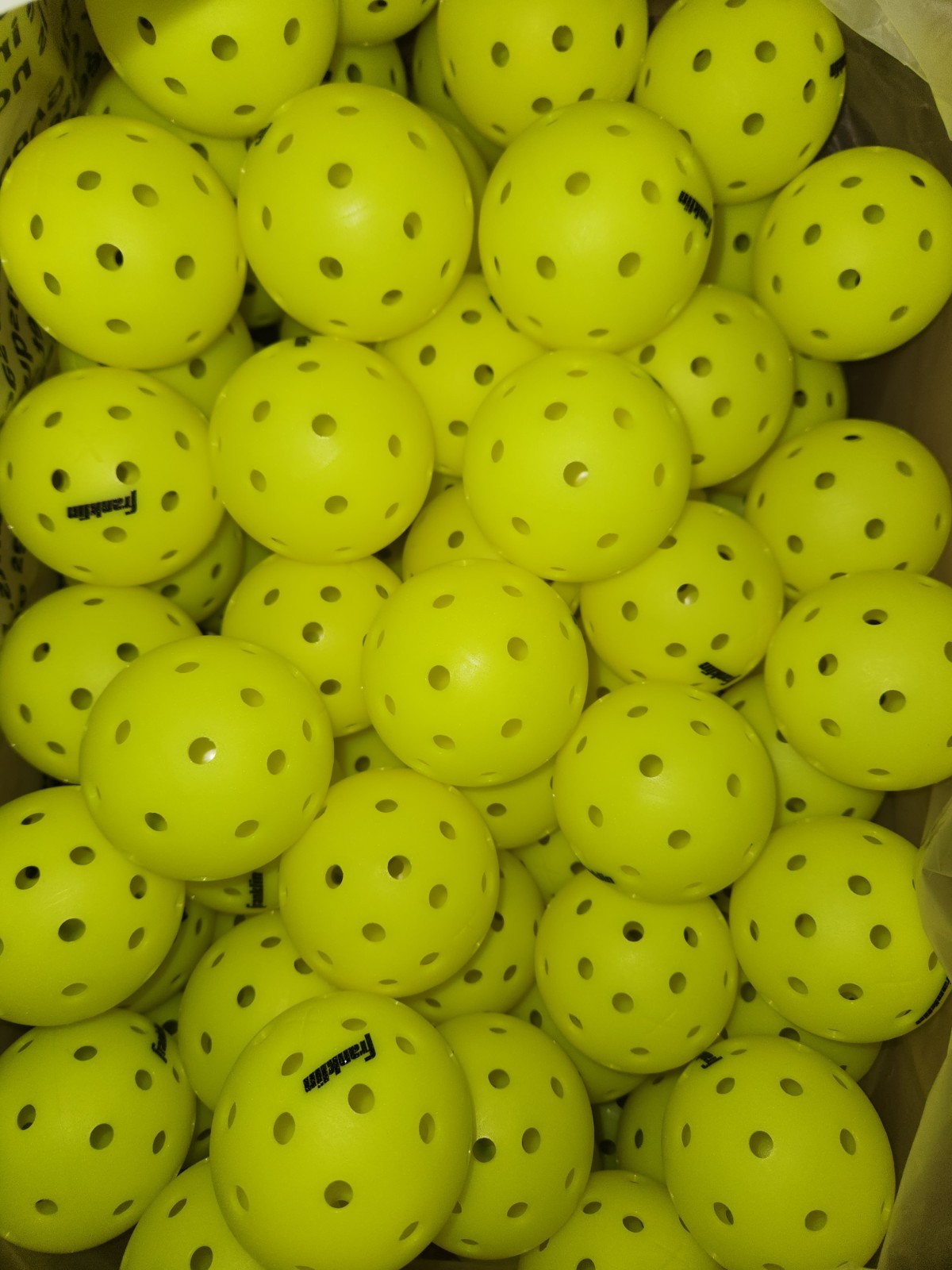

Photos from current listings. Actual item, color, and included accessories may vary.
Franklin Outdoor Pickleball Buying Guide
Franklin outdoor pickleballs are injection-molded, 40-hole balls built for asphalt and concrete play, where hardness, wall thickness, and hole uniformity determine flight stability and crack resistance far more than color. The core trade-off is bounce consistency versus durability: softer blends feel lively but deform and crack faster, while harder, thicker-walled builds fly true longer. Choose a 40-hole outdoor-specific model with a consistent seam and USAP approval for serious play, and skip any ball marketed as 'indoor/outdoor' for high-impact court use.


At a glance
- Category
- Pickleball Balls
- Data updated
- Nov 16, 2026
Current offers
Highlights
- Outdoor Franklin balls use a 40-hole pattern with smaller, tighter holes than 26-hole indoor balls, reducing wind drift and stabilizing flight on hard courts.
- Injection-molded construction creates a seamless, uniform wall, unlike two-piece welded balls that split at the equator under repeated hard hits.
- The X-40 is Franklin's outdoor flagship, USAP-approved and built with a harder blend than the indoor X-26, resisting deformation on rough asphalt.
- Wall thickness and blend hardness separate tiers: thicker, harder balls hold roundness longer, while thin soft balls offer better touch but crack sooner.
Best use cases
- Pick the X-40 40-hole outdoor ball for concrete, asphalt, and sport-court play where wind resistance and crack durability matter most.
- Choose a softer, thinner-wall outdoor ball only for recreational wood or smooth acrylic surfaces where touch and low bounce are priorities.
- Skip any 26-hole indoor ball outdoors: larger holes catch wind, and the softer shell deforms rapidly on abrasive hard courts.
- Skip 'hybrid' or 'multi-surface' balls for competitive outdoor play; dedicated 40-hole outdoor builds fly truer and last longer.
Buying tips
- Buy 40-hole balls for outdoor hard courts and 26-hole balls for indoor gym floors; hole count and size directly control wind drift and bounce.
- Prefer injection-molded seamless balls over welded two-piece designs; the seam is the first failure point under hard outdoor hits.
- Match ball hardness to court abrasion: harder blends survive asphalt, softer blends suit smooth acrylic or wood.
- Confirm USAP approval if you play sanctioned or tournament pickleball; approved models meet diameter, weight, and bounce standards.
Specs
| Hole Pattern | 40 holes outdoor / 26 indoor |
|---|---|
| Construction | Injection-molded seamless vs welded |
| USAP Approval | Approved (X-40) / not approved |
| Regulation Size | 2.874-2.972 in, 0.78-0.935 oz |
Related searches
What to check before buying
- Verify your playing surface: concrete or asphalt needs 40-hole outdoor balls, while gym or wood floors need 26-hole indoor balls.
- Check paddle and ball compatibility: USA Pickleball-approved balls pair correctly with standard paddles for tournament bounce consistency.
- Confirm ball diameter stays within the 2.874-2.972 inch range and weight near 0.78-0.935 oz for regulation play.
- Plan for ball rotation: outdoor balls wear and crack, so buy in multi-packs and retire any ball with visible cracks or soft spots.
FAQ
Data sources: eBay / Amazon listings and product attribute feeds Data updated Nov 16, 2026.
Some links on this page are affiliate links. If you buy after clicking one, we may earn a commission at no extra cost to you. This does not change which products appear here or their order. Affiliate disclosure.