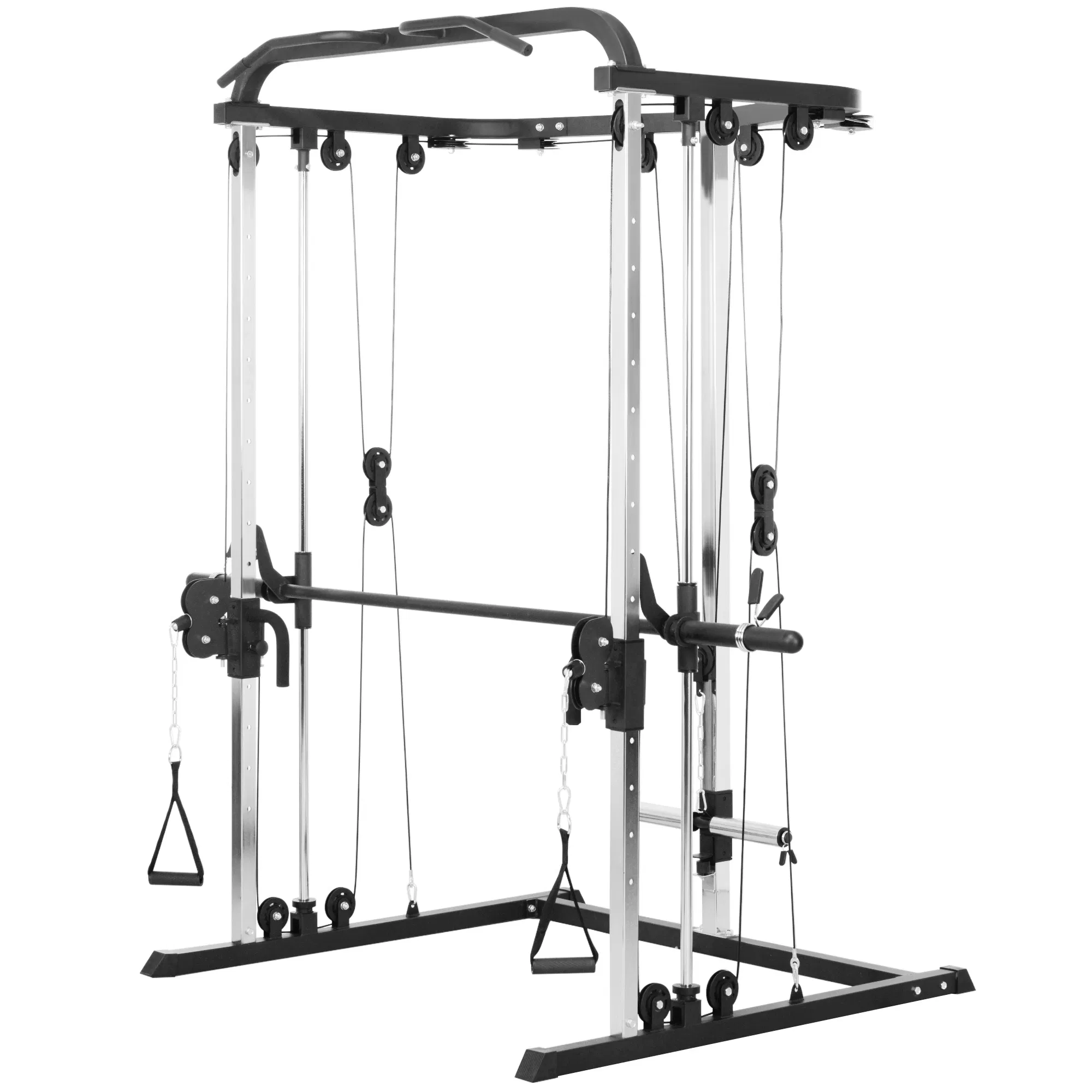

Photos from current listings. Actual item, color, and included accessories may vary.
Power Rack With Cable Crossover Buying Guide
A power rack with cable crossover combines a squat/press cage with a dual-pulley functional trainer, letting you perform barbell lifts and cable isolation in one footprint. The primary trade-off is frame steel gauge and pulley smoothness versus overall footprint and assembly complexity. Buy a rack with at least 11-gauge steel, a 2x2-inch or 3x3-inch upright, and dual independent pulleys if you want lasting cable performance; skip 14-gauge tubular racks with single-pulley crossovers for serious lifting.


At a glance
- Category
- Power Racks, Benches & Platforms
- Data updated
- Nov 16, 2026
Current offers
Highlights
- Upright steel gauge drives stability: 11-gauge (about 3mm) rack frames resist flex under heavy squats; 14-gauge (about 2mm) flexes and is best for light cable work.
- Cable crossover pulley count and ratio matter: dual independent pulleys with 2:1 ratio give smooth 1:1 resistance feel; single-pulley crossovers feel jerky and limit unilateral work.
- Hole spacing on uprights: 1-inch Westside spacing in the bench/press zone enables precise J-hook and safety-arm placement; 2-inch spacing forces compromise on rack-pull height.
- Weight capacity and anchor points: a rack rated 1,000 lb or more with 4 floor anchor points and a 2x3-inch or 3x3-inch base resists tipping during kipping pull-ups and heavy cable rows.
Best use cases
- Best fit: a home gym with 8-foot ceilings and a concrete floor — pick a 90-inch-tall rack with dual pulleys and 1-inch hole spacing for full barbell and cable training in one station.
- Wrong fit: a garage with a sloped floor or carpet — skip any rack without adjustable leveling feet; cables will bind and the frame will rock under load.
- Best fit: lifters who need both heavy squats and cable flyes — choose a rack with a 2x3-inch 11-gauge frame and a crossover rated for at least 200 lb per side.
- Wrong fit: a low-clearance basement under 7 feet — skip 90-inch racks; pick a squat-stand-style crossover or a short rack under 80 inches, or you cannot press overhead.
Buying tips
- Measure ceiling height and add 6 inches for pull-up clearance: a 90-inch rack needs at least 96 inches to the ceiling for overhead press and chin-ups.
- Check upright dimensions: 3x3-inch 11-gauge uprights accept standard 1-inch hardware and magnetic attachments; 2x2-inch 14-gauge racks use 5/8-inch holes and fewer accessories.
- Cable ratio: a 2:1 pulley system means 100 lb on the stack feels like 50 lb at the handle; buy a stack rated at least double your target cable resistance.
- Footprint math: a rack with a crossover typically requires at least 48 inches of depth and 60 inches of width; add 24 inches front and back for bar and cable travel.
Specs
| Frame Steel Gauge | 11-gauge (3mm) vs 14-gauge (2mm) |
|---|---|
| Upright Size | 3x3 in vs 2x2 in |
| Pulley System | Dual independent 2:1 vs single |
| Hole Spacing | 1 in Westside vs 2 in standard |
Related searches
What to check before buying
- Ceiling height at least 96 inches for a 90-inch rack plus overhead clearance; measure to the lowest obstruction, including garage door tracks.
- Floor must be level concrete or rubber matting at least 0.5-inch thick; skip carpet or sloped surfaces unless the rack has adjustable leveling feet.
- Barbell compatibility: confirm the rack's J-hooks and safeties accept your bar diameter (28-32mm) and that the rack width fits a standard 7-foot Olympic bar.
- Required companion parts: weight plates or a selectorized stack for the crossover, a bench that fits inside the rack depth, and floor anchors or weight storage to prevent tipping.
FAQ
Data sources: eBay / Amazon listings and product attribute feeds Data updated Nov 16, 2026.
Some links on this page are affiliate links. If you buy after clicking one, we may earn a commission at no extra cost to you. This does not change which products appear here or their order. Affiliate disclosure.