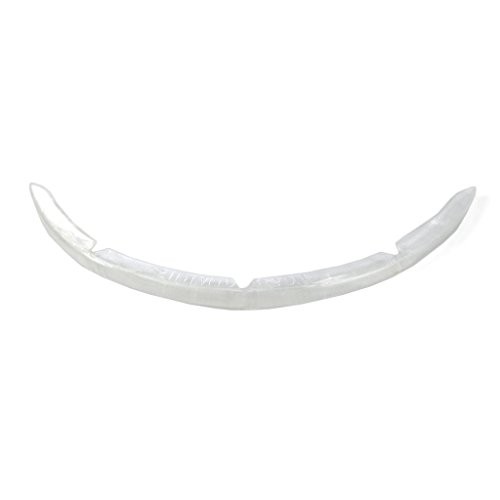

Photos from current listings. Actual item, color, and included accessories may vary.
Nose Guard Buying Guide
A nose guard is a protective cap or bumper applied to a surfboard's nose to absorb impact from the leash plug, rail, or sand and prevent ding-causing fractures. The primary trade-off is between a rigid, high-durometer polymer that maximizes impact resistance and a softer, more conformable material that fits complex nose curves without lifting. Choose a guard whose hardness and adhesive system match your board's nose geometry and construction; skip universal 'one-size' rubber tips that peel off after a few sessions.


At a glance
- Category
- Surfboard Repair & Safety
- Data updated
- Nov 16, 2026
Current offers
Highlights
- Hardness matters: 80-95A polyurethane or TPU guards resist impact and abrasion far better than soft 50-60A rubber, which deforms and peels under repeated leash strikes.
- Adhesive systems vary: pressure-sensitive acrylic tape is convenient but fails in heat and saltwater; two-part epoxy or methacrylate adhesives bond permanently to polyester and epoxy resins.
- Nose shape dictates fit: narrow shortboard noses need low-profile, pointed caps; funboard and longboard noses require wider, pre-curved shells sized by nose width in inches.
- UV-stabilized clear polymers resist yellowing and embrittlement, while cheap vinyl guards crack within one season of sun exposure.
Best use cases
- Best fit: shortboard riders who frequently leash-wrap or transport boards in crowded vehicles should choose a low-profile 90A TPU cap with epoxy adhesive for maximum durability.
- Best fit: funboard and longboard owners should pick a wider, pre-curved clear guard sized to the nose width (typically 4-6 inches) and install with a flexible methacrylate adhesive to accommodate curvature.
- Wrong fit: soft slip-on rubber tips or foam guards on high-impact noses—these compress, trap water, and peel; skip them for any board used in shorebreak or rocky lineups.
- Wrong fit: universal 'trim-to-fit' guards on performance shortboards—trimming compromises the sealed edge and accelerates peeling; choose a model-specific shape instead.
Buying tips
- Match guard width to nose width: measure across the nose 1-2 inches back from the tip; a guard should cover 1/2 to 1 inch beyond each side of the stringer for adequate protection.
- Choose 80-95A hardness polyurethane or TPU for impact resistance; softer rubber (50-60A) is only suitable for light-duty longboard protection.
- Prefer epoxy or methacrylate adhesive over acrylic tape for permanent bonding on polyester and epoxy boards; tape-only guards require periodic replacement.
- Select UV-stabilized clear or opaque polymer; clear guards should be rated for UV resistance to prevent yellowing and cracking.
Specs
| Material Hardness | 80-95A PU/TPU vs 50-60A rubber |
|---|---|
| Adhesive Type | Epoxy/methacrylate vs acrylic tape |
| Nose Fit Width | 4-6 in pre-curved vs trim-to-fit |
| UV Resistance | UV-stabilized clear vs standard vinyl |
Related searches
What to check before buying
- Measure your board's nose width 2 inches from the tip and confirm the guard's stated coverage width exceeds it by at least 1 inch total.
- Check your board's resin type (polyester or epoxy) and choose an adhesive compatible with both; epoxy adhesives bond to both, while some solvent-based adhesives attack EPS cores.
- Verify the guard's profile height—low-profile (under 0.5 inch) for shortboards to avoid leash tangling, higher profile for longboards needing more impact absorption.
- Inspect the guard's edge seal design; a rounded, sealed lip prevents water intrusion and salt creep that lifts adhesive over time.
FAQ
Data sources: eBay / Amazon listings and product attribute feeds Data updated Nov 16, 2026.
Some links on this page are affiliate links. If you buy after clicking one, we may earn a commission at no extra cost to you. This does not change which products appear here or their order. Affiliate disclosure.