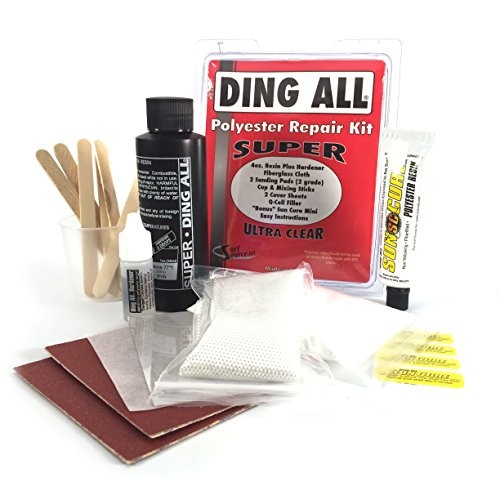

Photos from current listings. Actual item, color, and included accessories may vary.
Repair Kit Buying Guide
Surfboard repair kits bundle the resin, catalyst, fiberglass cloth, and tools needed to fix dings and delamination without a shop trip. The core trade-off is resin chemistry: polyester kits bond only to polyester (PU) foam boards, while epoxy kits are required for EPS/epoxy boards and will chemically melt PU foam if mismatched. Choose by board construction and damage size, not by kit size alone.


At a glance
- Category
- Surfboard Repair & Safety
- Data updated
- Nov 16, 2026
Current offers
Highlights
- Polyester resin kits cure in 15–30 minutes with MEKP catalyst and bond only to PU/polyester boards; epoxy resin kits cure in 45–90 minutes and are mandatory for EPS/epoxy boards.
- Fiberglass cloth weight determines repair strength: 4 oz cloth suits small dings and leash-plug reinforcement, 6 oz for deck dings, 8–10 oz for bottom delamination and fin-box areas.
- Catalyst ratio is critical: polyester MEKP is typically 1–2% by volume (roughly 10–20 drops per ounce), and excess catalyst causes brittle, yellowing, hot-curing repairs.
- Complete kits include sandpaper (80/120/220 grit), mixing cups, stir sticks, gloves, and a squeegee; bare resin-only kits force separate tool sourcing and usually cost more in total.
Best use cases
- Pick a polyester kit for classic PU/poly boards with small pressure dings, rail cracks, or leash-plug leaks; skip it entirely on EPS/epoxy boards where it will dissolve the foam core.
- Pick an epoxy kit for EPS/epoxy boards, soft-top cores, and any repair over 1 inch wide where flex fatigue demands a stronger bond; expect longer cure and stricter 2:1 or 5:1 mix ratios.
- Pick a fiberglass-cloth-included kit for deck dings, fin-box cracks, and delamination; pick a resin-only kit only if you already stock 4 oz and 6 oz cloth and sanding tools.
- Skip travel-size single-ding kits for anything larger than a quarter; a 1 oz resin kit covers roughly a 2-inch ding, so buy 2–4 oz kits for multiple repairs or rail damage.
Buying tips
- Match resin to core: polyester resin for PU/polyester boards, epoxy resin for EPS/epoxy boards — mislabeling is the top cause of melted foam and failed repairs.
- Size the kit by resin volume: 1 oz covers a ding up to ~2 inches, 2 oz up to ~4 inches, 4 oz handles multiple dings or a fin-box repair; buy one tier up for rail damage.
- Confirm cloth weight and quantity in the kit: 4 oz cloth for small dings, 6 oz for deck/bottom repairs, and at least two 4x4-inch squares per repair for proper overlap.
- Check catalyst type and ratio: MEKP for polyester (1–2% by volume), fixed-ratio pumps or pre-measured packets for epoxy; avoid kits with no ratio instructions.
Specs
| Resin Type | Polyester vs Epoxy (core-matched) |
|---|---|
| Resin Volume | 1 oz / 2 oz / 4 oz tiers |
| Cloth Weight | 4 oz / 6 oz / 8-10 oz fiberglass |
| Cure Time | 15-30 min poly / 45-90 min epoxy |
Related searches
What to check before buying
- Identify board core and skin: PU/polyester boards accept polyester kits; EPS/epoxy and soft-top boards require epoxy kits — check the stringer or label if unsure.
- Measure the damage: dings under 1 inch need 1 oz resin and 4 oz cloth; deck dings and fin-box cracks need 2–4 oz resin and 6 oz cloth.
- Confirm workspace conditions: resin needs 65–80°F and low humidity to cure; cold garages cause tacky, uncured epoxy and yellowed polyester.
- Verify included tools: sandpaper in 80/120/220 grit, mixing cups, stir sticks, gloves, and a squeegee; add a respirator for polyester MEKP fumes and epoxy vapors.
FAQ
Data sources: eBay / Amazon listings and product attribute feeds Data updated Nov 16, 2026.
Some links on this page are affiliate links. If you buy after clicking one, we may earn a commission at no extra cost to you. This does not change which products appear here or their order. Affiliate disclosure.