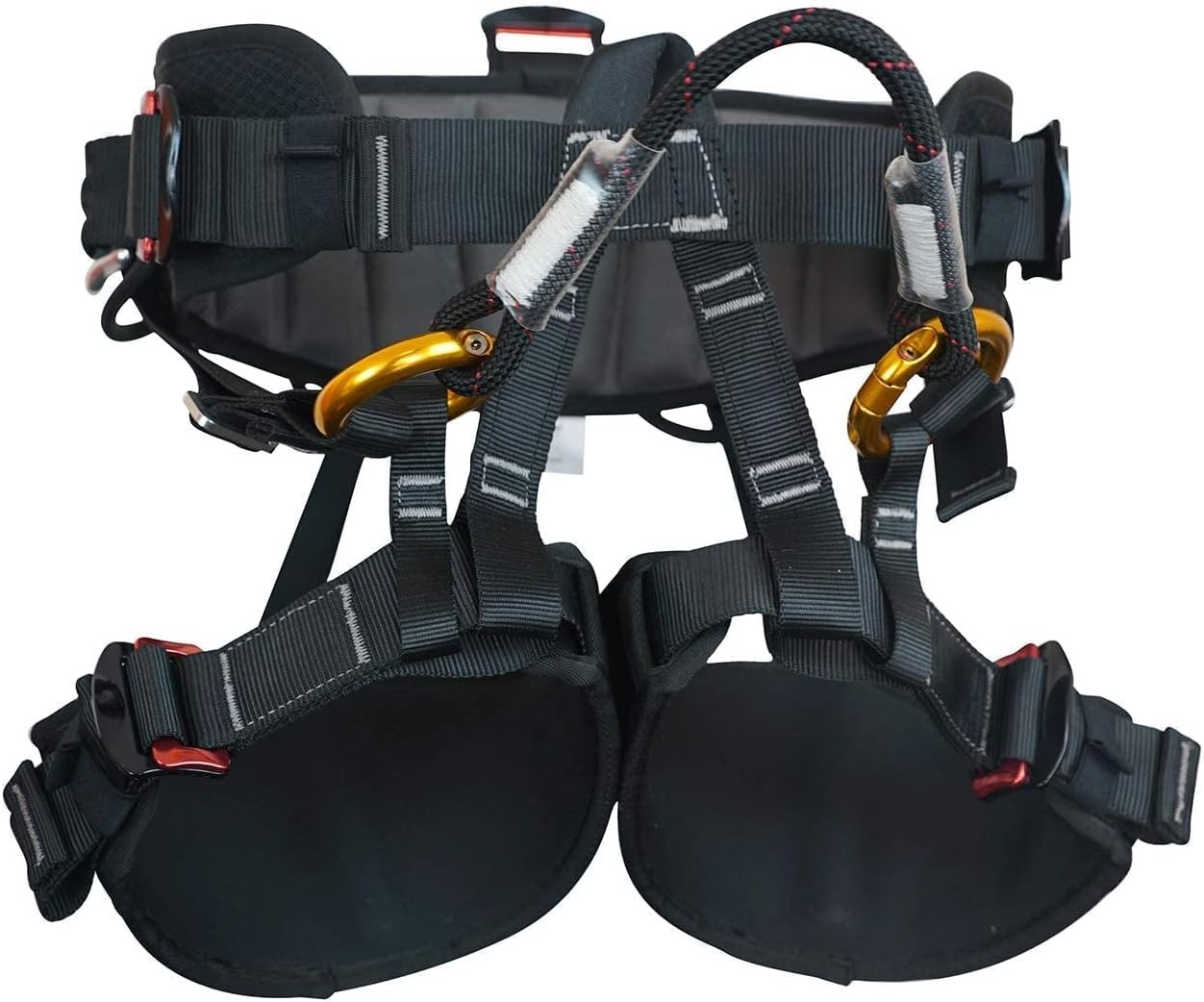

Photos from current listings. Actual item, color, and included accessories may vary.
Tree Climbing Harness Kit Buying Guide
A tree climbing harness kit pairs a sit-or-half-body arborist saddle with a bridge/rope system for positioning and fall arrest in canopy work. The decisive trade-off is between a certified, padded work saddle with replaceable bridge and a lightweight recreational half-harness with fixed webbing. Buy only kits rated EN 358/EN 813 (or ANSI Z359) with load-tested hardware; skip fashion or unlabeled bundles with no batch traceability.


At a glance
- Category
- Climbing Harnesses, Ropes & Quickdraws
- Data updated
- Nov 16, 2026
Current offers
Highlights
- Arborist saddles use a load-rated bridge (typically 22–24 kN MBS) plus side D-rings for work positioning; sport half-harnesses omit a bridge entirely.
- CE/EN 358 governs work-positioning belts and lanyards; EN 813 governs sit harnesses; ANSI Z359.11/Z359.3 sets U.S. fall-arrest and positioning hardware standards.
- Padding density and width at leg loops and waist (closed-cell foam over 40–50 mm webbing) determine multi-hour comfort; fixed webbing harnesses chafe within 30 minutes.
- Quick-buckle vs. threaded buckles: auto-locking quick-connect buckles speed sizing but add inspection points; aluminum D-rings save weight, steel D-rings resist abrasion in bark contact.
Best use cases
- Best fit: canopy pruning and removal work — pick a sit saddle with wide padded leg loops, two side D-rings, and a replaceable bridge; add a separate EN 358 lanyard.
- Best fit: beginner recreational tree climbing — pick a kit with a full-body or chest-and-seat harness, rated 11 mm+ static rope, and a friction hitch system; skip work-positioning saddles without a chest attachment.
- Wrong fit: fall-arrest-only construction — a fall-arrest harness without positioning D-rings cannot support sustained rope work; buy an EN 813 sit harness instead.
- Wrong fit: oversized rope — 12.5–13 mm ropes exceed most arborist prusik/mechanical hitch compatibility; match rope diameter to hitch cord and device spec.
Buying tips
- Measure waist and thigh circumference, not pants size: harness sizing ranges typically span 5–8 cm per size, and leg-loop fit must allow a flat hand's width of clearance.
- Match rope diameter to hardware: 11–12 mm ropes are standard for tree work; hitch cords should be 8–10 mm and within 60–80% of main rope diameter.
- Check certification labels: look for EN 358, EN 813, or ANSI Z359 markings plus a serial/batch number and manufacture date — unmarked webbing has no verifiable strength.
- Replace any kit component after a fall or 5 years of service; UV-degraded webbing (faded, stiff, fuzzy) loses strength before visible fraying.
Specs
| Harness Type | Arborist sit saddle vs half-body |
|---|---|
| Certification | EN 358 / EN 813 / ANSI Z359 |
| Bridge Rating | 22–24 kN MBS replaceable bridge |
| Rope Diameter | 11–12 mm static/semi-static |
Related searches
What to check before buying
- Confirm your tree's rope-anchor height and canopy spread: kits need rope at least 3–4 m longer than the highest anchor point plus tie-off tail.
- Verify fit range covers your waist and thighs with clothing layers; winter layers add 2–4 cm to circumference.
- Check local voltage/plug is irrelevant — but confirm hardware is rated for outdoor UV exposure and salt/humidity if coastal.
- Ensure you have a compatible friction hitch cord, carabiners (triple-lock for life support), and a helmet before first ascent.
FAQ
Data sources: eBay / Amazon listings and product attribute feeds Data updated Nov 16, 2026.
Some links on this page are affiliate links. If you buy after clicking one, we may earn a commission at no extra cost to you. This does not change which products appear here or their order. Affiliate disclosure.