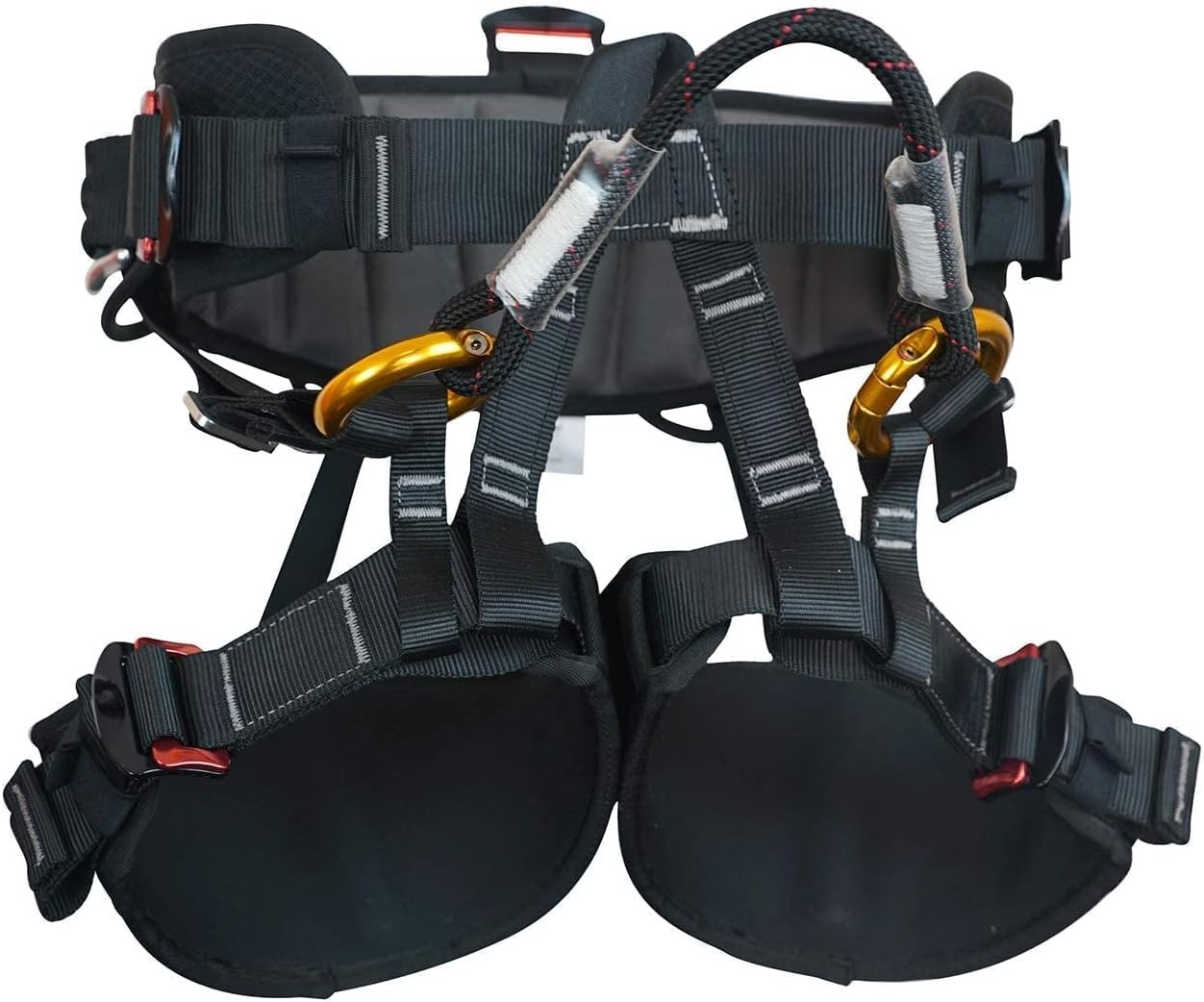

Photos from current listings. Actual item, color, and included accessories may vary.
Tree Harness Buying Guide
A tree harness is a work-positioning or fall-arrest harness built for arborists, climbers, and rescue users who need hands-free stability around trunks and limbs. The primary trade-off is between a full-body fall-arrest harness and a sit-stand arborist saddle: saddles prioritize all-day comfort and work positioning, while full-body harnesses prioritize fall-arrest compliance. Buy a certified arborist saddle with a floating bridge and rated side D-rings for tree work; treat generic half-body climbing harnesses as sport-climbing gear, not tree-cutting equipment.


At a glance
- Category
- Climbing Harnesses, Ropes & Quickdraws
- Data updated
- Nov 16, 2026
Current offers
Highlights
- Arborist saddles use a floating bridge (adjustable webbing or rope) with two side D-rings for work positioning; sport harnesses have one belay loop and no side attachment points.
- Certification matters: look for EN 358 (work positioning), EN 813 (sit harness), and ASTM F887 (arc-flash) where applicable; fall-arrest full-body harnesses require EN 361 or ANSI Z359.11.
- Leg loops and waist belt should be 45-50 mm wide minimum with closed-cell foam padding; narrow webbing digs in during long suspended saw work.
- Hardware must be rated: aluminum alloy D-rings and buckles at 15 kN or higher, with self-locking buckles or quick-connect buckles that meet EN 12277 for climbing harnesses.
Best use cases
- Best fit: arborist saddle with floating bridge, side D-rings, and gear loops for tree trimming and climbing with a chainsaw — choose this for chainsaw work in the canopy.
- Wrong fit: a lightweight sport-climbing half harness has no side D-rings or work-positioning rating; skip it for tree cutting and use it only for gym or rock climbing.
- Best fit: full-body fall-arrest harness with dorsal D-ring and sternal attachment for bucket-truck or lift work where fall arrest is the primary hazard — pair with a shock-absorbing lanyard.
- Wrong fit: a rescue or caving half harness without gear loops or a bridge is not a substitute for a tree saddle; choose a purpose-built arborist saddle for saw work.
Buying tips
- Match harness type to task: EN 358 work-positioning saddle for climbing/trimming; EN 361 full-body harness for fall arrest from lifts or ladders.
- Check sizing by waist and thigh circumference, not clothing size; most saddles fit waist 70-120 cm and thighs 50-75 cm with adjustable webbing.
- Confirm bridge type: adjustable rope bridge allows length tuning for limb walking; fixed webbing bridge is simpler but less versatile.
- Verify buckles are self-locking or quick-connect and D-rings are forged aluminum; stamped sheet-metal rings and friction buckles are a durability compromise.
Specs
| Harness Type | Arborist saddle vs full-body fall-arrest |
|---|---|
| Certification | EN 358 / EN 813 / ASTM F887 |
| Attachment Points | Side D-rings + floating bridge |
| Rope Compatibility | 11-13 mm arborist rope |
Related searches
What to check before buying
- Measure waist and thigh circumference with work clothing on; ensure the saddle's stated range covers both with at least 5 cm of adjustment margin.
- Confirm your rope diameter matches the saddle's bridge and attachment hardware: 11-13 mm arborist ropes are standard; 9-10 mm ropes suit sport harnesses.
- Check for gear loops and a saw lanyard attachment point if you will carry a chainsaw or hand saw into the canopy.
- Verify certification labels (EN 358, EN 813, ASTM F887) are stitched or stamped on the harness, not just claimed in the listing title.
FAQ
Data sources: eBay / Amazon listings and product attribute feeds Data updated Nov 16, 2026.
Some links on this page are affiliate links. If you buy after clicking one, we may earn a commission at no extra cost to you. This does not change which products appear here or their order. Affiliate disclosure.