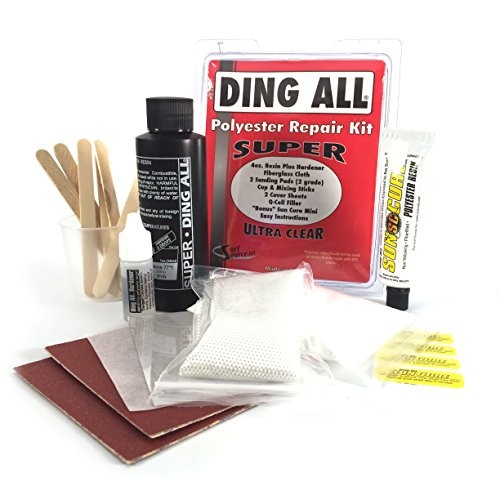

Photos from current listings. Actual item, color, and included accessories may vary.
Surfboard Repair Kit Buying Guide
A surfboard repair kit is a pre-packaged set of resin, catalyst, cloth, and tools for fixing dings, cracks, and delamination on fiberglass or epoxy boards. The primary trade-off is resin chemistry: polyester kits are cheap and fast but only bond to polyester (PU) foam/fiberglass boards, while epoxy kits are stronger, waterproof, and compatible with EPS foam but cost more and cure slower. The clear decision rule: match the resin system to your board's core and glassing, never mix polyester resin onto an epoxy board.


At a glance
- Category
- Surfboard Repair & Safety
- Data updated
- Nov 18, 2026
Current offers
Highlights
- Polyester resin kits use MEKP catalyst at roughly 1-2% by volume; they cure in 20-30 minutes but dissolve EPS foam and won't adhere to epoxy boards.
- Epoxy kits use 2:1 or 5:1 resin-to-hardener ratios; they bond to both PU and EPS cores, are waterproof, and cure in 1-24 hours depending on hardener speed.
- Fiberglass cloth weight matters: 4 oz (120 g/m²) is standard for ding repair; 6 oz (200 g/m²) adds strength for larger cracks and tail repairs.
- Kits with sandpaper, mixing cups, and spreaders save sourcing time; quality kits include 80/120/220-grit wet/dry paper and a proper squeegee.
Best use cases
- Best fit: PU (polyurethane) foam board with polyester glassing and small dings under 2 inches — choose a polyester kit for fastest cure and lowest cost.
- Best fit: EPS (expanded polystyrene) core or epoxy-glass board of any size damage — choose an epoxy kit; polyester will melt the core and fail to bond.
- Wrong fit: structural damage (broken fin box, deep crack to the stringer, delamination over 6 inches) — these need professional lamination or a full repair kit with cloth layers, not a ding kit.
- Best fit: travel and emergency repair — pick a compact kit with pre-measured resin packets and self-adhesive cloth patches; skip bulk kits with separate catalyst bottles.
Buying tips
- Match resin to board: polyester resin only for PU foam and polyester glass; epoxy resin for EPS foam and epoxy glass — cross-use causes melting or poor adhesion.
- Check kit volume: 1-2 oz of mixed resin covers a ding up to 2 inches; 4 oz covers up to 6 inches; buy larger only if repairing multiple dings or large cracks.
- Catalyst ratio is critical for polyester: too little MEKP leaves a sticky surface; too much causes exothermic cracking — follow 1-2% by volume and measure with the included dropper.
- For epoxy kits, confirm hardener speed: fast (5-15 min pot life) for quick repairs, slow (30-60 min) for hot climates or large laminations to avoid premature gelling.
Specs
| Resin Type | Polyester vs Epoxy |
|---|---|
| Core Compatibility | PU / EPS / Both |
| Cloth Weight | 4 oz / 6 oz fiberglass |
| Cure Time | 20 min (poly) / 1-24 hr (epoxy) |
Related searches
What to check before buying
- Identify your board's core material (PU foam vs EPS foam) and glassing type (polyester vs epoxy) before choosing a kit — this is the single compatibility factor.
- Measure the damage: dings under 2 inches need only resin and cloth; cracks longer than 6 inches or delamination may require multiple cloth layers and a larger resin volume.
- Check ambient temperature: polyester and epoxy cure best between 65-85°F (18-30°C); below 60°F curing stalls, above 90°F pot life shortens dramatically.
- Confirm kit includes PPE: nitrile gloves, mixing sticks, and sandpaper — resin is skin-sensitizing and MEKP is corrosive; kits without gloves are false economy.
FAQ
Data sources: eBay / Amazon listings and product attribute feeds Data updated Nov 18, 2026.
Some links on this page are affiliate links. If you buy after clicking one, we may earn a commission at no extra cost to you. This does not change which products appear here or their order. Affiliate disclosure.