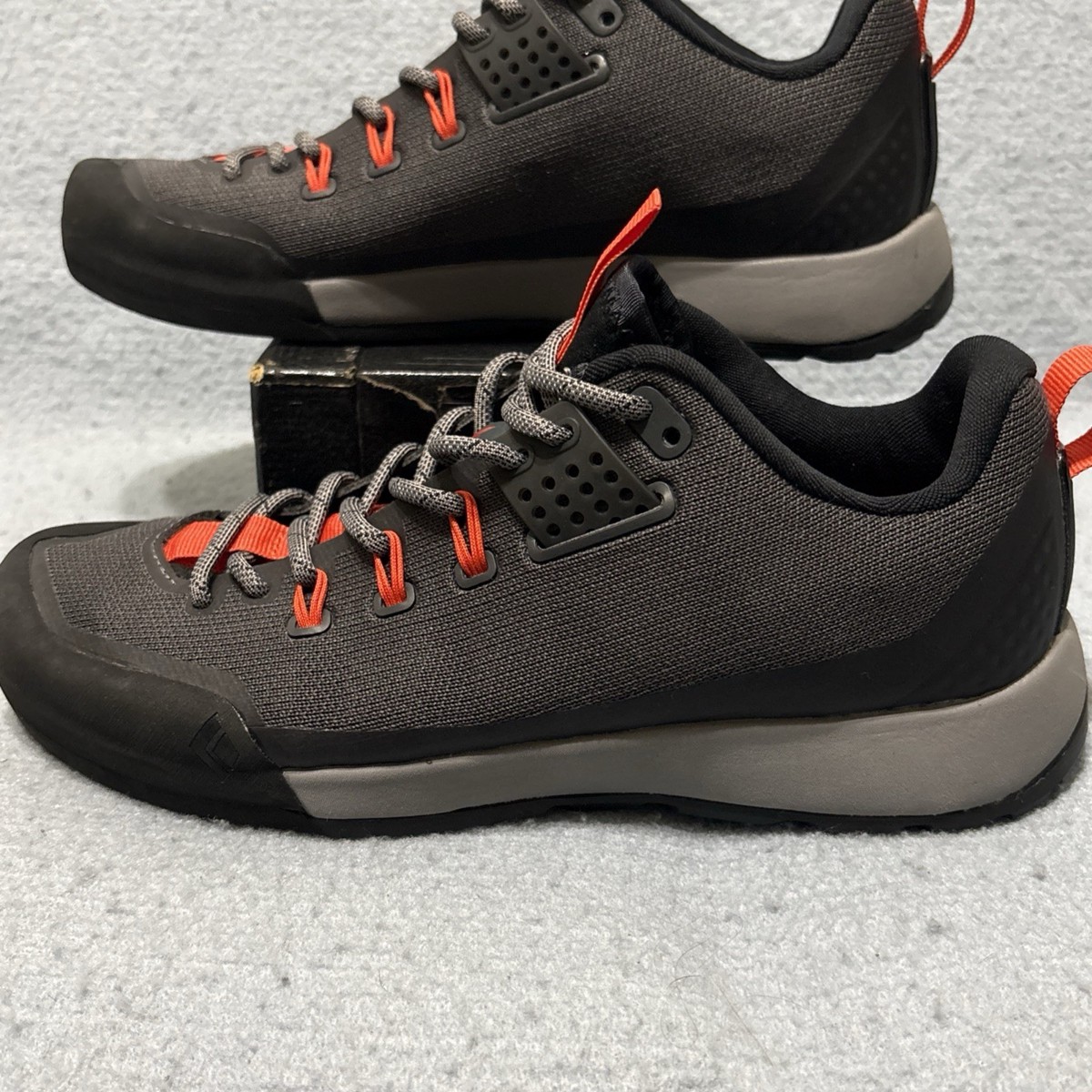

Photos from current listings. Actual item, color, and included accessories may vary.
Black Diamond Climbing Shoe Buying Guide
Black Diamond climbing shoes are a focused line of rock shoes and approach trainers built around their own rubber and last shapes, not a full-category me-too brand. The core trade-off is between stiff, edging-oriented flat-last models for all-day vertical terrain and softer, downturned models for steep bouldering and gym performance. The clear rule: buy Black Diamond when you want a specific flat or mid-asym last with durable rubber and you can match the last shape to your foot width; skip if you need an aggressively downturned competition shoe or a wide-size run to try locally.


At a glance
- Category
- Climbing & Bouldering Shoes
- Data updated
- Nov 20, 2026
Current offers
Highlights
- Black Diamond uses its own BlackLabel rubber compound across the line, tuned softer on the Momentum and Zone for smearing and stiffer on the Aspect and Technician for edging support.
- The Momentum and Zone are flat-last, low-asymmetry shoes with a neutral profile; the Aspect adds a slightly asymmetric last for vertical edging, while the Technician is an approach/hiking shoe, not a climbing shoe.
- Closure architecture splits the line: lace models (Momentum Lace, Aspect) give fine volume control for narrow or high-volume feet, while hook-and-loop models (Momentum, Zone) prioritize fast on/off for gym laps.
- Black Diamond shoes use a full-length or partial midsole depending on tier; the stiffer midsole on the Aspect and Zone supports small edges, while the softer Momentum flexes for smearing and long multi-pitch comfort.
Best use cases
- Best fit: gym and sport climbers logging high volume who want a comfortable flat-last shoe with hook-and-loop closure—pick the Momentum or Zone in your street size or half-size down.
- Best fit: trad and multi-pitch climbers who need all-day edging support and fine lacing control—pick the Aspect lace in your street size, not downsized.
- Wrong fit: steep bouldering or competition-style problems requiring aggressive downturn and high asymmetry—skip Black Diamond and choose a dedicated downturn last.
- Wrong fit: buyers treating the Technician as a climbing shoe—it is an approach/hiking shoe with a sticky outsole, so choose a true rock shoe for vertical terrain.
Buying tips
- Size Black Diamond flat-last shoes at street size to half-size down; the Momentum and Zone run close to true-to-size, while the Aspect lace runs slightly narrower and rewards street size for all-day wear.
- Match last asymmetry to terrain: low-asym flat lasts (Momentum, Zone) for smearing and comfort, moderate-asym lasts (Aspect) for vertical edging—avoid downsizing more than one full size on any flat last.
- Check closure against your session: hook-and-loop for gym laps and bouldering, lace for multi-pitch and precise volume control; lace models add grams but lock the midfoot.
- Treat the Technician strictly as an approach shoe: its outsole is sticky rubber for scrambling, not a climbing-specific rand or last, so do not size it like a rock shoe.
Specs
| Last Profile | Flat low-asym to moderate-asym |
|---|---|
| Closure Type | Hook-and-loop or lace |
| Rubber Compound | BlackLabel sticky rubber |
| Midsole Stiffness | Soft to stiff by model |
Related searches
What to check before buying
- Measure your foot length and width in millimeters and compare to Black Diamond's size chart—flat-last models fit average-to-wide feet, so narrow feet should size down or choose lace models.
- Confirm closure and last: hook-and-loop flat last for gym volume, lace moderate-asym last for vertical edging, and approach shoe only for hiking-to-crag use.
- Check resole feasibility: Black Diamond shoes use standard rand and sole construction that most cobblers can resole, so buy the upper fit first and plan on one or two resoles.
- Verify your gym or crag style: if your sessions are steep and plastic-heavy, a flat-last Black Diamond shoe will underperform compared with a downturn-specific model.
FAQ
Data sources: eBay / Amazon listings and product attribute feeds Data updated Nov 20, 2026.
Some links on this page are affiliate links. If you buy after clicking one, we may earn a commission at no extra cost to you. This does not change which products appear here or their order. Affiliate disclosure.