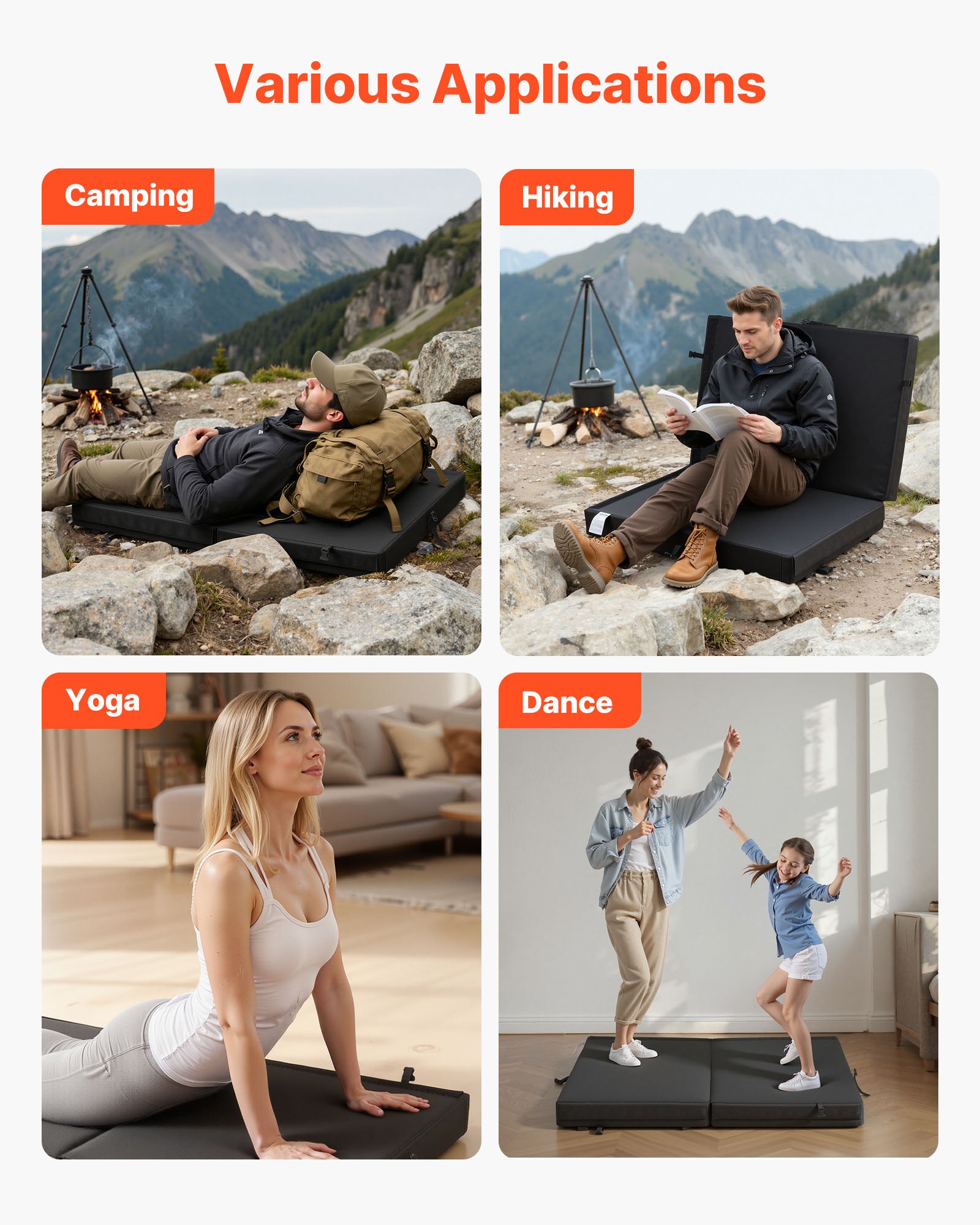

Photos from current listings. Actual item, color, and included accessories may vary.
Bouldering Pad Buying Guide
A bouldering pad is a portable foam landing system that absorbs falls from low-height climbing, and the core trade-off is foam quality versus portability: dense closed-cell PE base foam plus open-cell PU comfort foam protects against impact, while thinner or single-layer foam saves weight but bottoms out on repeated falls. The decision rule is simple—buy a pad with a closed-cell base layer and a rated fall height that matches your climb height, and skip any pad that lists only 'high-density foam' without a foam spec.


At a glance
- Category
- Climbing Helmets & Protection
- Data updated
- Nov 17, 2026
Current offers
Highlights
- Foam architecture: quality pads use a closed-cell polyethylene (PE) base layer for impact dispersion plus open-cell polyurethane (PU) top layer for comfort; single-foam pads compress permanently after repeated falls.
- Hinge design: bi-fold pads fold once for carrying and are simpler and lighter; tri-fold pads fold twice for a smaller packed size but add hinge seam gaps that can catch a heel.
- Closure and carry: adjustable backpack straps and a waist belt distribute pad weight on the approach; a pad without a hip belt or with thin shoulder straps becomes miserable on long approaches.
- Shell fabric: 600D–1000D polyester or nylon ripstop with a waterproof PU coating resists abrasion and moisture; thin 210D shells wear through at landing zones within a season.
Best use cases
- Best fit: bi-fold pad with closed-cell PE + open-cell PU foam, 600D+ shell, and backpack straps for gym-to-outdoor bouldering and moderate approaches—pick this as the all-around default.
- Best fit: tri-fold or larger coverage pad (roughly 4 ft x 5 ft open) for highball problems and rocky landings where the extra landing zone and smaller packed size justify the weight.
- Wrong fit: a thin single-layer foam pad or a pad under about 3 inches thick for outdoor rock—it will bottom out on pointy landings and offers little protection on repeated falls.
- Wrong fit: a pad without a closed-cell base layer for gym use only—gym floors already absorb impact, so a cheap open-cell pad is acceptable indoors but never outdoors.
Buying tips
- Match open size to fall height: a pad roughly 4 ft x 5 ft (about 1.2 m x 1.5 m) covers typical bouldering landings; smaller pads force you to stack two pads for highballs.
- Check foam thickness: 4–5 inches total is the standard for outdoor bouldering; 3 inches or less is a gym or kids' pad, and 6+ inches adds bulk for marginal gain.
- Verify shell denier: 600D–1000D polyester/nylon with a waterproof coating is the durability floor; anything listed as 210D or unspecified will abrade at the landing zone.
- For used pads, inspect for foam compression (press the center—it should spring back), cracked hinge seams, and delaminated shell fabric; compressed foam cannot be restored.
Specs
| Foam Layers | Closed-cell PE base + open-cell PU top |
|---|---|
| Pad Thickness | 4–5 in outdoor / 3 in gym |
| Fold Style | Bi-fold vs tri-fold |
| Shell Fabric | 600D–1000D PU-coated polyester/nylon |
Related searches
What to check before buying
- Measure your vehicle trunk and closet: a bi-fold pad packs to roughly 35 x 24 x 8 inches, so confirm it fits your storage and transport space before buying.
- Check the approach distance: pads with backpack straps and a hip belt suit long approaches; simple handle-only pads are for short carries from car to crag.
- Confirm the landing terrain: rocky or sloping landings need a larger pad or two pads; flat gym floors and sandy landings tolerate a smaller single pad.
- Verify shell water resistance if you climb in wet climates—a PU-coated shell keeps foam from soaking up water, which adds weight and degrades foam.
FAQ
Data sources: eBay / Amazon listings and product attribute feeds Data updated Nov 17, 2026.
Some links on this page are affiliate links. If you buy after clicking one, we may earn a commission at no extra cost to you. This does not change which products appear here or their order. Affiliate disclosure.