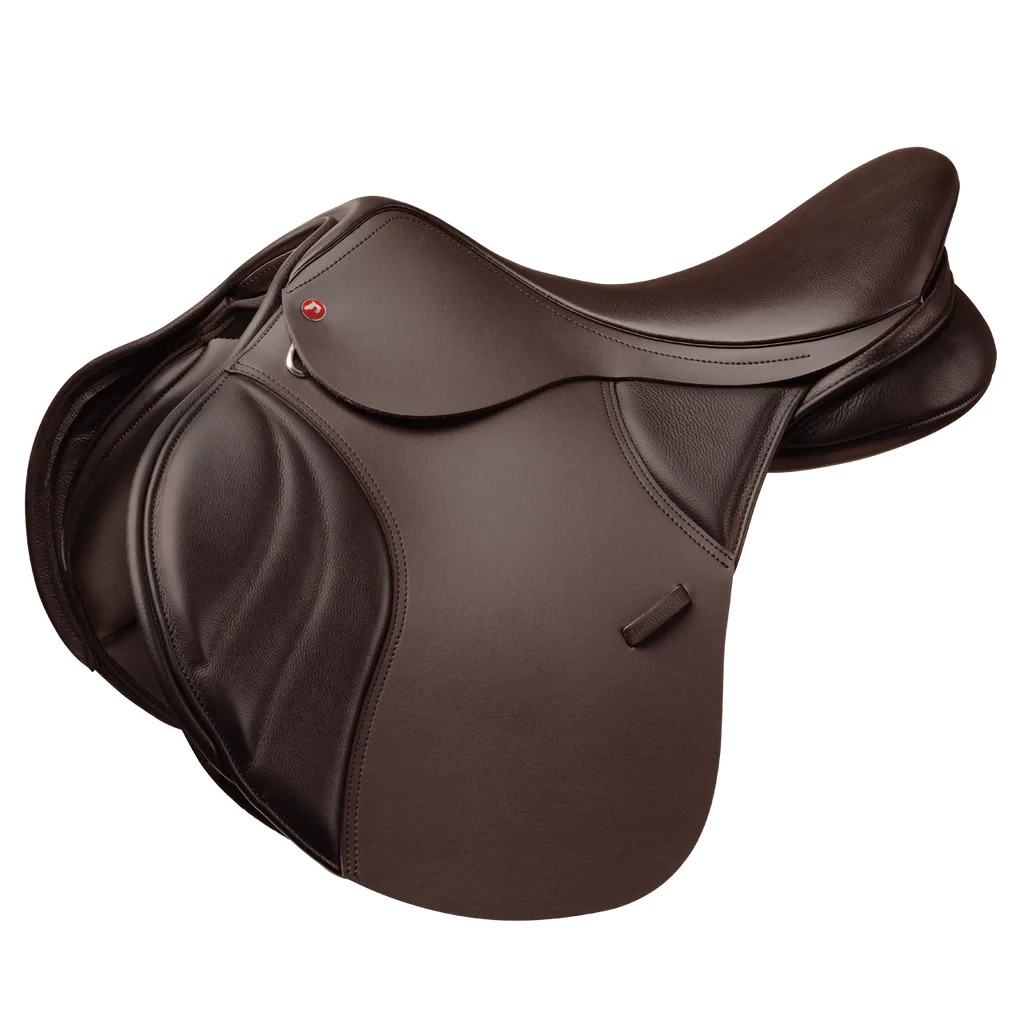

Photos from current listings. Actual item, color, and included accessories may vary.
Jumping Saddle Buying Guide
A jumping saddle is a close-contact English saddle built for show jumping and hunter courses, where a forward flap and flat seat let the rider shorten stirrups and stay off the horse's back over fences. The decisive trade-off is flap angle and seat depth versus general-purpose comfort: a true jumping saddle has a forward-cut flap (typically 12–14 inches deep from pommel to flap tip) and a shallow seat, while a dressage or all-purpose saddle will restrict your leg position over jumps. Buy a dedicated close-contact jump saddle if you school or compete over fences at 2'6" and higher; skip it if your riding is mostly flatwork or trail.


At a glance
- Category
- Equestrian Saddles & Pads
- Data updated
- Nov 18, 2026
Current offers
Highlights
- Close-contact jumping saddles have a forward flap angled to accommodate a short stirrup length, typically 2–4 inches shorter than flatwork length, keeping the rider's knee bent and weight centered over the horse's balance point.
- Seat depth separates disciplines: jumping seats are shallow (1.5–2.5 inches) to allow rapid position changes; dressage seats are deep (3–4 inches) and will lock you into a chair seat over fences.
- Tree width must match the horse's wither measurement: narrow (regular) trees fit 8–9 inch withers, medium 9–10 inches, wide 10–11 inches; a mismatched tree causes pressure points and refused jumps.
- Panel flocking material (wool vs. foam) determines long-term fit: wool flocking can be adjusted by a saddler, foam panels are fixed and compress over 3–5 years of heavy use.
Best use cases
- Best fit: riders jumping 2'6"–3'6" courses several times a week — choose a close-contact jumping saddle with a forward flap (12–14 inch depth) and medium tree; skip all-purpose saddles that put your leg behind the motion over fences.
- Best fit: hunter/jumper competitors needing precise release and two-point position — pick a flat-seated jumping saddle with a narrow twist and short flap; skip deep-seat eventing or dressage models that restrict hip angle.
- Wrong fit: trail or flatwork-only riders — a jumping saddle's shallow seat and forward flap cause lower-leg instability at long stirrup lengths; choose a dressage or endurance saddle instead.
- Wrong fit: growing riders or shared lesson horses — an adjustable-gullet all-purpose saddle covers multiple horses; a fixed-tree jumping saddle only fits one wither profile and is a poor multi-horse investment.
Buying tips
- Measure your horse's wither: place a flexible curve over the withers and measure the arc in inches; a jumping saddle tree within 0.5 inch of that measurement prevents bridging and rocking.
- Match flap length to your leg: inseam under 30 inches needs a short flap (11–12 inch), 30–33 inches a regular (12–13 inch), 34+ a long flap (13–14 inch); a too-long flap blocks your knee over fences.
- For used saddles, check panel condition first: wool flocking should be even and resilient with no hard lumps; foam panels older than 5 years are compressed and will need replacement costing more than the saddle's value.
- Confirm gullet width and channel clearance: the channel must clear the horse's spine by at least 2.5 inches on each side; narrow channels on cheap saddles cause direct spinal pressure over jumps.
Specs
| Discipline | Close-contact jumping / hunter-jumper |
|---|---|
| Flap Depth | 12-14 in forward-cut |
| Seat Depth | Shallow 1.5-2.5 in |
| Tree Width | Narrow / Medium / Wide (8-11 in) |
Related searches
What to check before buying
- Measure your horse's wither arc and back length before selecting tree width and panel size; a 16-inch seat typically fits a 15–16 hand horse, 17-inch fits 16–17 hands.
- Check your stirrup leather length in jumping position: you need 2–4 inches shorter than flatwork, so verify the flap depth covers your knee without catching.
- Confirm billets and girth compatibility: jumping saddles use long billets with a short girth; mixing with a dressage-length girth requires a converter or different billet setup.
- Inspect used saddle leather grade: full-grain calfskin lasts decades with conditioning; corrected-grain or bonded leather cracks within 2–3 seasons of heavy jumping use.
FAQ
Data sources: eBay / Amazon listings and product attribute feeds Data updated Nov 18, 2026.
Some links on this page are affiliate links. If you buy after clicking one, we may earn a commission at no extra cost to you. This does not change which products appear here or their order. Affiliate disclosure.