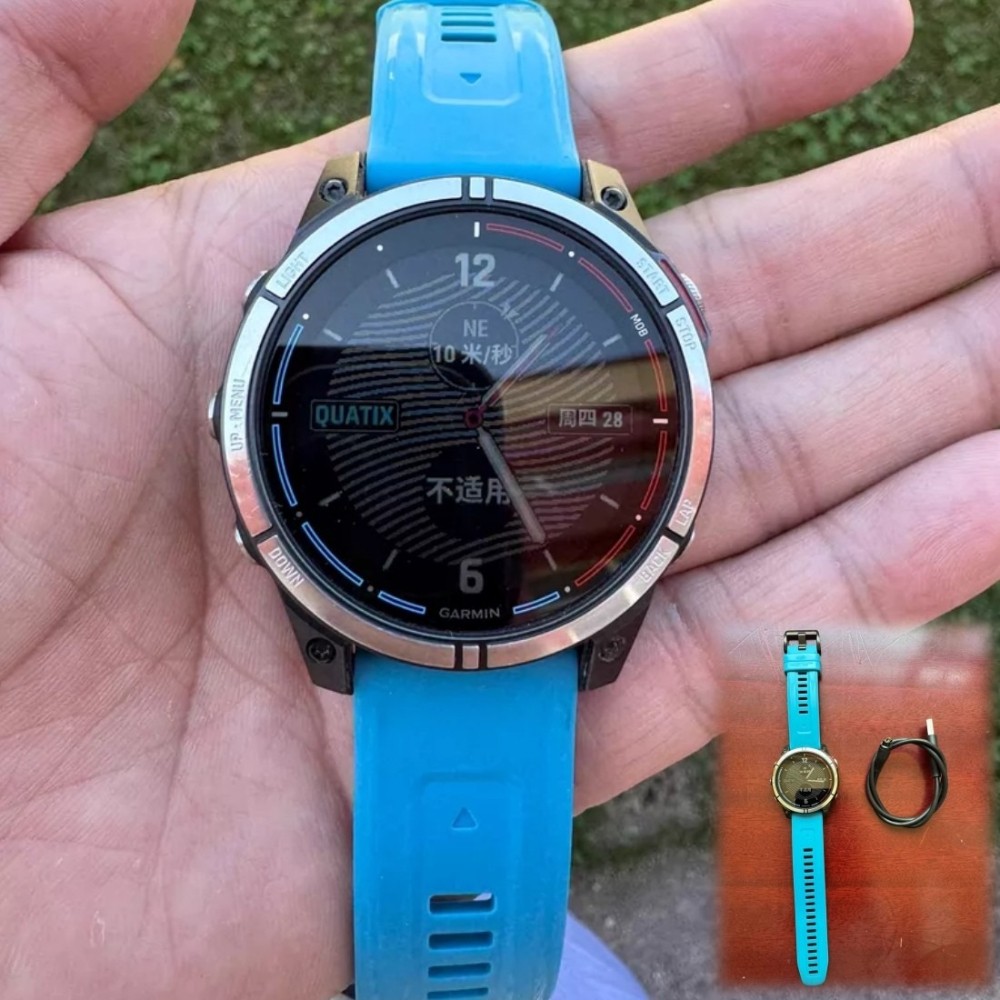

Photos from current listings. Actual item, color, and included accessories may vary.
Garmin Smartwatch Buying Guide
Garmin smartwatches span distinct architectures—from outdoor multisport GPS units to AMOLED lifestyle and marine-specific models—so the core trade-off is display technology versus battery endurance and sensor tier. Buyers must decide between MIP transflective displays for weeks-long runtime or AMOLED for color and touch at multi-day runtime, then match the sensor package (Elevate optical heart rate generation, multi-band GNSS, mapping) to their activity. The clean decision rule: choose the series by battery and navigation need first, then the tier by sensor and material upgrades—skip any model lacking the specific activity profile or map support you require.


At a glance
- Category
- Smartwatches & Fitness Wearables
- Data updated
- Nov 16, 2026
Current offers
Highlights
- Display split: MIP transflective screens deliver 2-4 weeks per charge with always-on visibility, while AMOLED panels cut runtime to roughly 4-14 days depending on always-on settings.
- Sensor tiers: Elevate V4 optical heart rate plus Pulse Ox appears on mid-to-high models; multi-band GNSS (L1+L5) improves urban and canyon GPS accuracy versus single-band receivers.
- Navigation: full-color TopoActive maps, multi-continent mapping, and ABC sensors (altimeter, barometer, compass) are reserved for higher tiers; base models rely on breadcrumb tracks.
- Marine architecture: quatix series adds nautical features—tide data, anchor drag, autopilot control—and shares the Fenix-class case with MIP or AMOLED display options.
Best use cases
- Trail running and ultramarathon: pick a MIP-display Fenix/Enduro-class model for multi-week battery and full TopoActive maps; skip AMOLED lifestyle models that need weekly charging on long events.
- Daily wear with fitness tracking: choose a Venu or vivoactive AMOLED model for color touch and smart notifications; skip bulky Fenix tiers unless you need mapping or multi-band GNSS.
- Marine and watersports: the quatix line (quatix 7 Standard uses MIP) is the correct pick for tide, anchor, and autopilot integration; skip general fitness models lacking nautical software.
Buying tips
- Match display to recharge cadence: MIP models go 2-4 weeks between charges, AMOLED models typically 4-14 days; always-on AMOLED can halve that figure.
- For GPS accuracy in cities or canyons, require multi-band GNSS; single-band receivers drift in dense environments and under tree cover.
- Case sizing matters: 42-43 mm cases suit wrists under about 170 mm circumference; 47 mm and larger Fenix-class cases fit wrists above roughly 175 mm.
- Map storage: full TopoActive mapping ships per region; confirm the unit includes your continent's map set rather than relying on a base global background.
Specs
| Display Type | MIP transflective vs AMOLED touch |
|---|---|
| Battery Runtime | MIP 2-4 wk / AMOLED 4-14 days |
| GNSS Accuracy | Single-band vs multi-band L1+L5 |
| Case Size Range | 42-43 mm vs 47 mm+ tiers |
Related searches
What to check before buying
- Measure wrist circumference: 42-43 mm cases for under ~170 mm, 47 mm+ for ~175 mm and above—larger cases can overhang slim wrists.
- Confirm phone compatibility and OS version for Garmin Connect pairing; both iOS and Android are supported but notification features vary by OS.
- Check activity requirement: pool/Open-water swim rating (5 ATM or 10 ATM) and dive depth rating differ—10 ATM suits surface watersports, not scuba.
- Verify the charging cable standard (Garmin proprietary clip vs USB-C) and whether the model supports Wi-Fi map updates or requires cable sync.
FAQ
Data sources: eBay / Amazon listings and product attribute feeds Data updated Nov 16, 2026.
Some links on this page are affiliate links. If you buy after clicking one, we may earn a commission at no extra cost to you. This does not change which products appear here or their order. Affiliate disclosure.