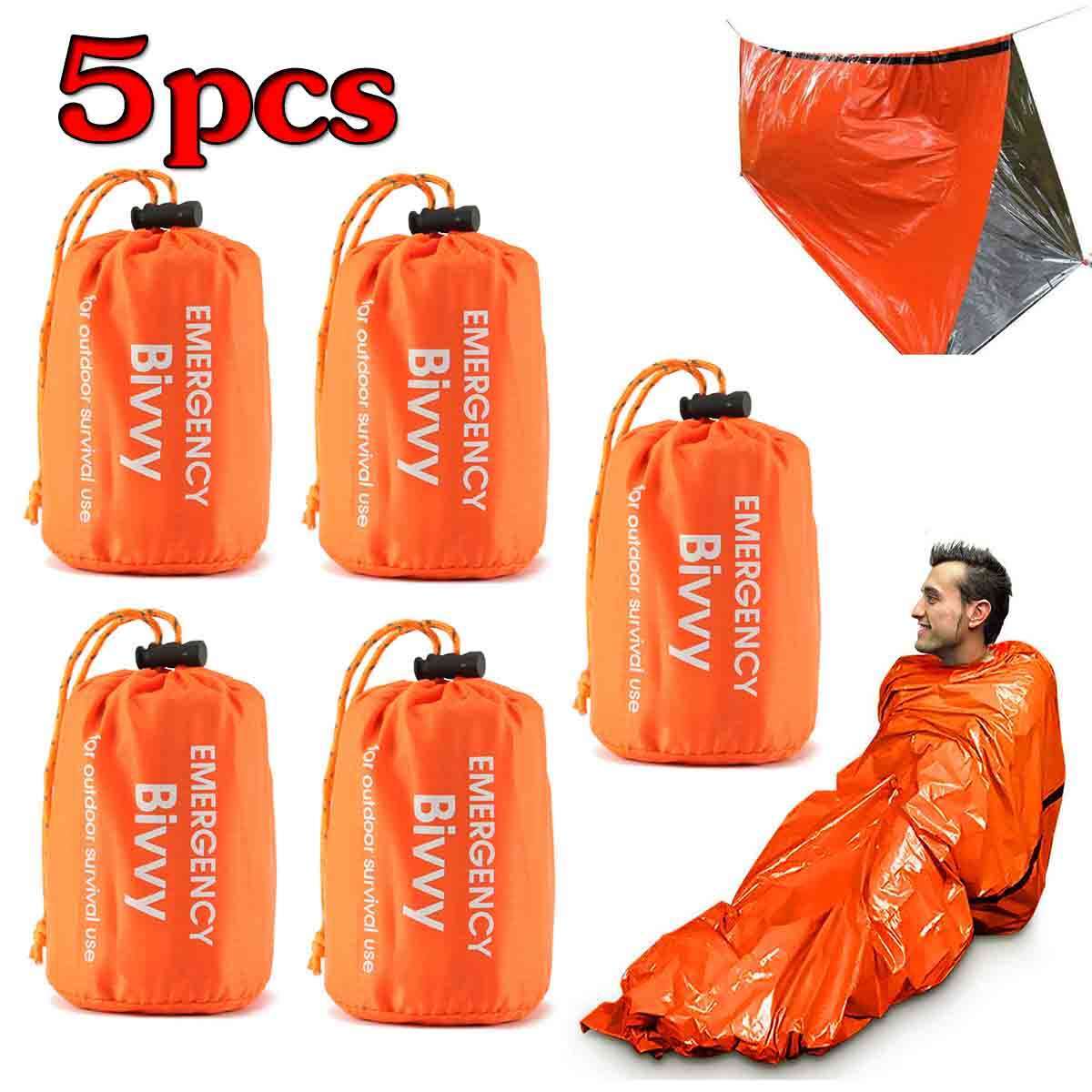

Photos from current listings. Actual item, color, and included accessories may vary.
Emergency Sleeping Bag Buying Guide
Emergency sleeping bags are compact, single-use or limited-reuse thermal survival shelters designed to prevent hypothermia when regular bedding is unavailable. The core trade-off is between reflective metallized film (lightest, cheapest, but fragile and non-breathable) and multi-layer reinforced laminates or bivvy-style construction (heavier, pricier, but reusable and tear-resistant). Choose metallized film for pure one-night emergency kits; choose reinforced or multi-use bags if you need a bag that survives repeated packing and rough ground.


At a glance
- Category
- Sleeping Bags, Pads & Cots
- Data updated
- Nov 17, 2026
Current offers
Highlights
- Metallized polyethylene terephthalate (PET) film reflects up to 90% of radiant body heat but tears at under 2 lb of force and has near-zero breathability, causing condensation.
- Reinforced emergency bags use a scrim or woven core laminated between reflective layers, raising tear strength above 10 lb and allowing 5–20 reuse cycles.
- Bivvy-style emergency bags add a breathable membrane or vented footbox, reducing internal condensation at the cost of slightly lower radiant reflectivity.
- Pack size and weight scale with material: film bags compress to palm-size under 4 oz; reinforced or multi-layer bags run 8–16 oz and pack to a fist or 1-liter bottle size.
Best use cases
- Best fit: one-per-person vehicle, hiking, or 72-hour kit where pack volume and weight dominate—pick a metallized film bag under 4 oz and accept single-use lifespan.
- Best fit: basecamp, cabin, or repeated emergency prep where the bag will be unpacked and repacked—choose a reinforced scrim-laminate or bivvy-style bag rated for multiple uses.
- Wrong fit: sub-freezing winter camping as a primary sleep system—emergency bags retain heat but lack insulation loft; pair with a pad and additional insulation or choose a dedicated cold-weather bag.
- Wrong fit: daily Scout or youth-group use where bags are handled roughly—film bags puncture and crease; supply reinforced bags or reusable bivvies instead.
Buying tips
- Match bag dimensions to user height plus 6–8 in: most emergency bags are 84 × 36 in flat or 84 × 24 in tube form; taller users need 90 in or bivvy cut.
- Check for a reinforced scrim or woven core in the spec—unreinforced 12-micron film is a one-night item, while 26-micron or scrim-backed film survives multiple packs.
- For vehicle kits, prioritize a bag with a stuff sack and high-visibility exterior; for backpacking, prioritize sub-4-oz weight and palm-size packed volume.
- Verify the bag includes a drawstring hood or corded opening—open-top film bags lose 20–30% of trapped heat around the neck and shoulders.
Specs
| Material | Metallized PET film vs scrim-laminate |
|---|---|
| Reuse Tier | Single-use vs 5-20 cycles |
| Packed Weight | Under 4 oz vs 8-16 oz |
| Opening Style | Drawstring hood vs open-top |
Related searches
What to check before buying
- Measure the longest user from crown to toe and add 8 in; confirm the bag's stated length meets or exceeds that number in both flat and tube configurations.
- Confirm storage volume against your kit: film bags pack to 4–6 in cylinders; reinforced bags need 1–2 liters of pack space.
- Check the opening style—drawstring hood, cord lock, or velcro—against your need for quick entry and heat retention in wind.
- For vehicle or boat kits, confirm the bag's exterior is high-visibility (orange, silver) and that the stuff sack attaches to a pack or dashboard strap.
FAQ
Data sources: eBay / Amazon listings and product attribute feeds Data updated Nov 17, 2026.
Some links on this page are affiliate links. If you buy after clicking one, we may earn a commission at no extra cost to you. This does not change which products appear here or their order. Affiliate disclosure.