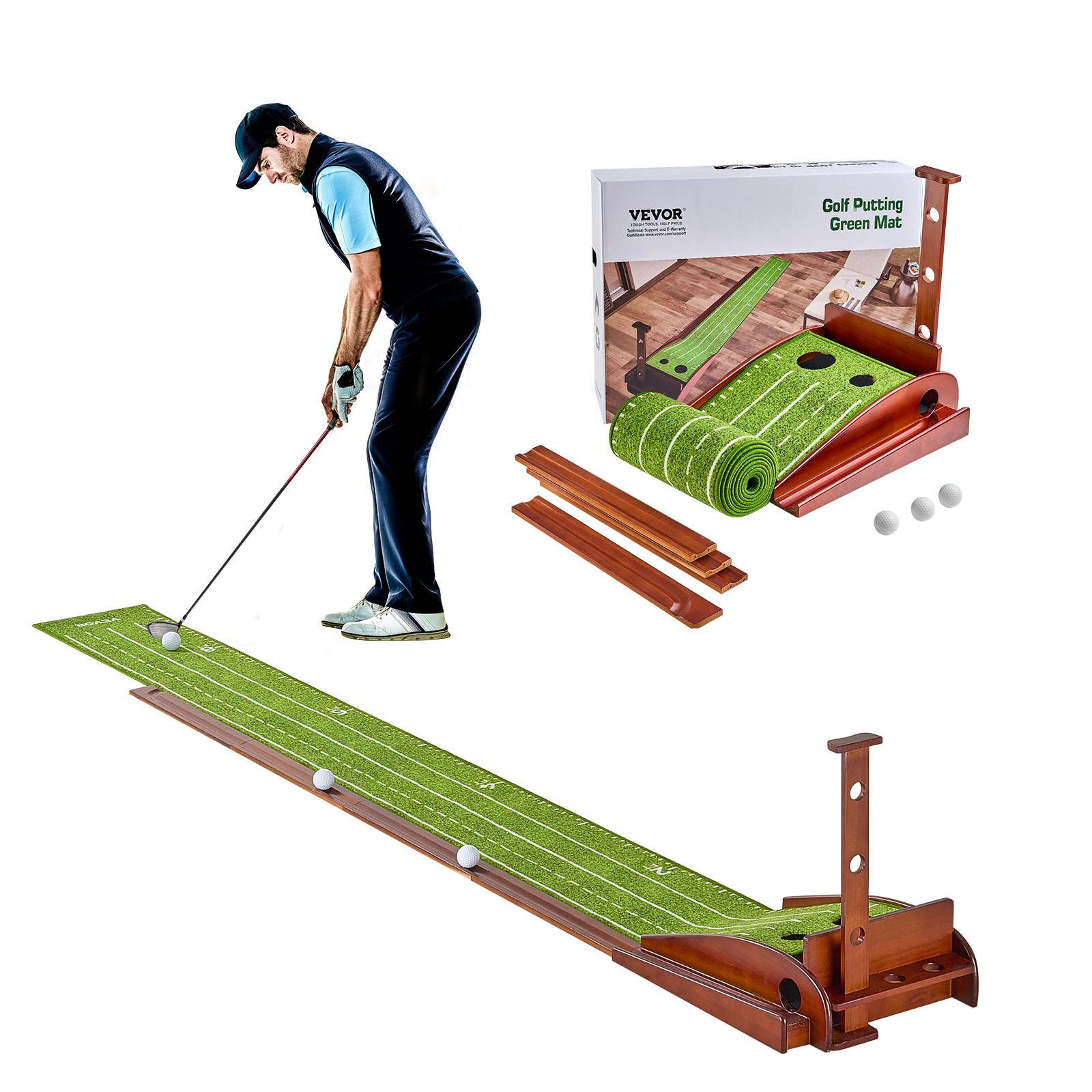

Photos from current listings. Actual item, color, and included accessories may vary.
Golf Putting Mat Buying Guide
A golf putting mat is a portable training surface that recreates the speed and roll of a real green, letting you practice stroke, alignment, and distance control indoors or in a yard. The defining trade-off is surface realism versus convenience: thick multi-layer turf with a true Stimpmeter roll and a solid sub-base costs more and needs floor space, while thin single-layer mats roll inconsistently and slide. The decision rule: buy a mat with a dense, dual-tone turf face, a non-slip or wood-backed base, and graduated hole sizes if you want measurable skill transfer; skip thin promotional mats that wrinkle and hold permanent creases.


At a glance
- Category
- Golf Training, Shoes & Gloves
- Data updated
- Nov 17, 2026
Current offers
Highlights
- Turf face density (GSM and pile height) determines roll consistency and speed: denser, shorter-pile synthetic turf rolls faster and truer than loose, shaggy surfaces.
- A rigid sub-base — wood, MDF, or high-density foam — prevents the wave and wrinkle that cause missed putts; roll-up mats without backing need time to flatten and never fully settle.
- Auto-ball-return mechanisms use either a gravity ramp or a spring-loaded track; gravity returns are more reliable long-term because there is no spring to weaken or jam.
- Graduated hole sizes (regulation 4.25-inch cup versus reduced-diameter training cups) force center-face contact and are the single best feature for stroke improvement.
Best use cases
- Best fit: a 10x5 ft wood-backed green with three regulation cups and flags for players who want to practice long lag putts and course-like reads; skip the small mini set if you need to work on speed control from beyond six feet.
- Best fit: a compact 2-hole auto-return mat on a hard floor for apartment or office practice focused on repeating a straight six-to-eight-foot putt; skip it if your floor is thick carpet, which destabilizes thin mats.
- Best fit: a roll-out turf mat for outdoor patio or garage use when you want to practice break and slope; skip indoor-only felt mats outdoors, as moisture and UV degrade unbacked felt quickly.
- Wrong fit: buying a mat longer than your available clear floor — a 10 ft mat needs at least 12 ft of unobstructed run-out behind the cup for the ball to settle.
Buying tips
- Match mat length to your stroke goal: 6-8 ft mats train short putts and alignment; 10-12 ft mats are required to practice lag putting and distance control.
- Demand a dual-density or dual-tone turf face — the two-tone stripe pattern is not decorative, it provides a visual alignment aid that improves start-line consistency.
- Check the backing: wood or MDF base holds shape permanently; foam-backed mats are lighter but compress over time; unbacked roll-ups wrinkle and require re-flattening.
- Confirm the return mechanism: gravity-ramp returns need a slight incline and a clean track; spring returns can weaken, so choose a gravity design for long-term reliability.
Specs
| Base Type | Wood/MDF vs Foam vs Unbacked turf |
|---|---|
| Turf Face | Dual-tone dense pile vs single felt |
| Cup Setup | Regulation 4.25 in vs reduced training cup |
| Ball Return | Gravity ramp vs spring track vs none |
Related searches
What to check before buying
- Measure clear floor length and width: add at least 2 ft behind the hitting end for backswing and 1 ft behind the cup for ball return clearance.
- Check floor type: hard flooring (wood, tile, concrete) suits thin and wood-backed mats; thick carpet requires a rigid sub-base or the mat will ripple.
- Verify cup size: regulation cups are 4.25 inches in diameter; reduced training cups (around 3 inches) are intentional and improve accuracy but change the practice feel.
- Confirm what is included: cups, flags, alignment guide, and balls are often sold separately, so a mat-only listing requires buying companion cups and a hole cutter.
FAQ
Data sources: eBay / Amazon listings and product attribute feeds Data updated Nov 17, 2026.
Some links on this page are affiliate links. If you buy after clicking one, we may earn a commission at no extra cost to you. This does not change which products appear here or their order. Affiliate disclosure.