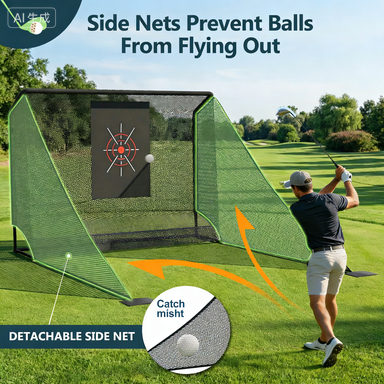

Photos from current listings. Actual item, color, and included accessories may vary.
Portable Golf Net Buying Guide
A portable golf net is a freestanding or stake-anchored impact enclosure that lets you hit full-swing shots into a backyard or garage without retrieving balls. The core trade-off is between thin single-layer netting that tears at high clubhead speeds and multi-layer or reinforced targets that absorb energy safely. Buy a net rated for your swing speed with a deep enclosure and side barriers; skip budget single-panel nets unless you only hit wedges.


At a glance
- Category
- Golf Training, Shoes & Gloves
- Data updated
- Nov 17, 2026
Current offers
Highlights
- Net material grade determines durability: 210D-420D Oxford or polyester knotless mesh resists 150+ mph ball speed; thin 150D or nylon netting frays at driver speeds.
- Enclosure depth of 3-4 ft and side barriers contain mis-hits; flat single-panel nets let shanked balls escape sideways and damage walls or fences.
- Frame type splits into fiberglass or steel pole frames with guy lines versus pop-up spring-steel hoops; pole frames stand up to repeated driver impact, pop-ups suit wedges and irons.
- Ball-return systems use a sloped back net or gutter channel to roll balls to the front; auto-return nets eliminate the stoop-and-retrieve cycle but add setup complexity.
Best use cases
- Backyard full-swing practice with driver: choose a 10x7 ft enclosure with side barriers, 420D reinforced netting, and ground stakes; skip pop-up nets and single-panel designs.
- Garage or indoor use with irons and wedges: pick a 7x7 ft or 8x8 ft net with a weighted base or sandbags and at least 2 ft of clearance behind the net; skip staked-only nets that need turf.
- Frequent setup and takedown on a range or field: choose a pop-up or collapsible pole frame with a carry bag under 20 lbs; skip heavy steel cage nets that take 20+ minutes to assemble.
- Junior or beginner practice at low swing speeds: a 7x7 ft single-layer net with stakes is adequate; skip oversized 10x7 enclosures that add cost and footprint without benefit.
Buying tips
- Match net width to miss pattern: a 10 ft wide net covers driver dispersion for most players; 7 ft width is only safe for irons and wedges with a centered stance.
- Check netting denier and construction: 210D Oxford or knotless polyester at 1-inch mesh or tighter holds up; avoid 150D or knotted nylon that develops holes at seams.
- Confirm frame anchoring: ground stakes work in turf, but garage and hard-surface setups need sandbags or weighted base legs; a net without anchoring hardware is incomplete.
- For auto ball return, verify a sloped back panel or gutter and a front lip; return nets need a smooth floor or mat to roll balls forward and a taut net to funnel correctly.
Specs
| Net Size | 7x7 to 10x7 ft enclosure |
|---|---|
| Net Material | 210D-420D Oxford / knotless mesh |
| Frame Type | Pole frame vs pop-up hoop |
| Ball Return | Auto-return slope vs manual retrieve |
Related searches
What to check before buying
- Measure ceiling or overhead clearance: full driver swing needs 9-10 ft; a garage net requires at least 1 ft of net above the tallest player's swing arc.
- Measure floor footprint: a 10x7 ft net needs roughly 12x10 ft of clear space including side barriers and 3-4 ft of ball-travel depth.
- Confirm anchoring surface: turf accepts stakes; concrete or gym floors require sandbags or weighted base, so buy a net that includes or supports them.
- Check included accessories: carry bag, stakes, and side barriers determine portability and safety; a net missing side barriers is a mis-hit hazard.
FAQ
Data sources: eBay / Amazon listings and product attribute feeds Data updated Nov 17, 2026.
Some links on this page are affiliate links. If you buy after clicking one, we may earn a commission at no extra cost to you. This does not change which products appear here or their order. Affiliate disclosure.