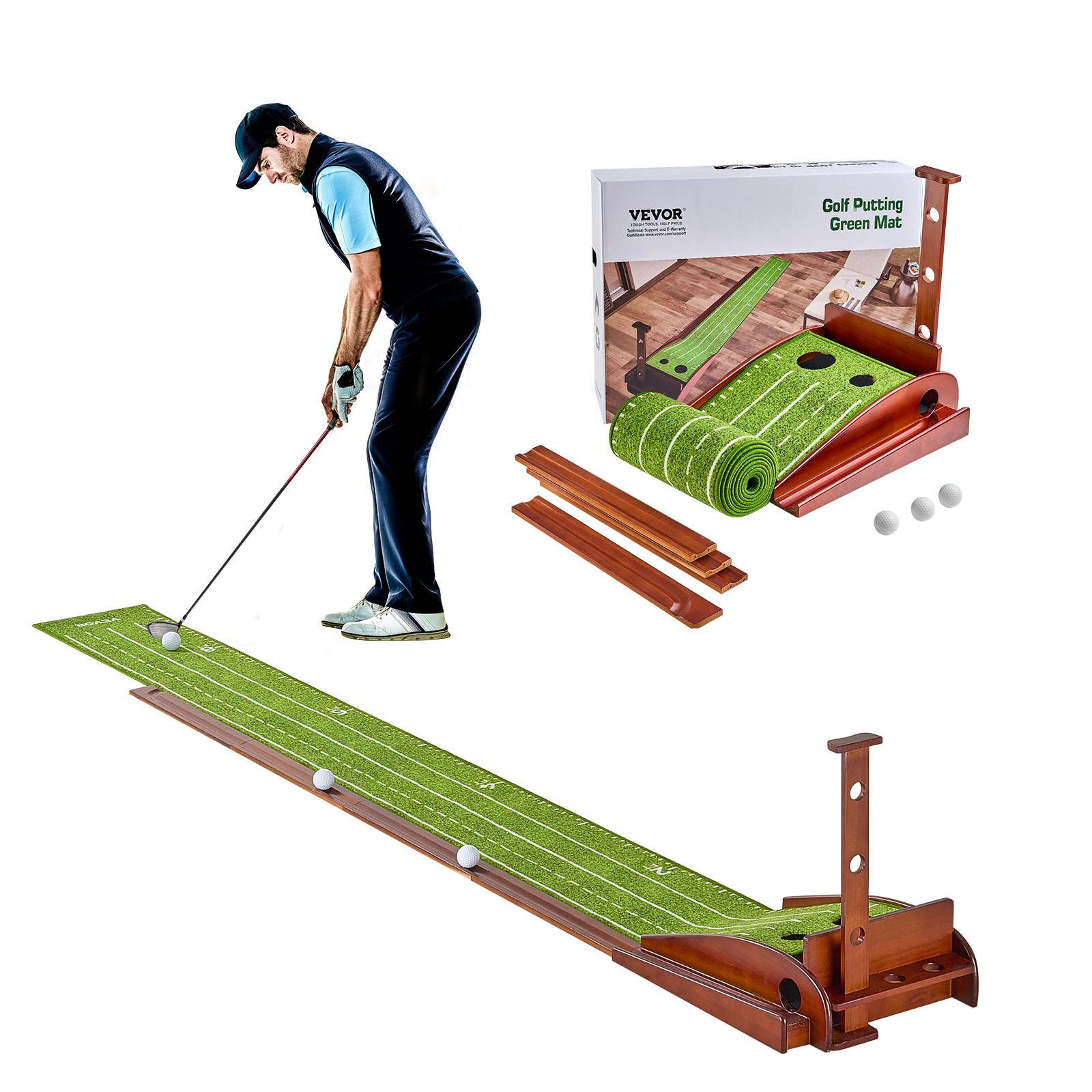

Photos from current listings. Actual item, color, and included accessories may vary.
Putting Mat Buying Guide
A putting mat is an indoor/outdoor training surface that uses turf density, base rigidity, and hole/return mechanics to simulate green-speed roll and build a repeatable stroke. The core trade-off is between thin rollable carpet (fast setup, poor ball-roll fidelity, wrinkles) and dense turf on a rigid wood or rubber base (truer roll, heavier, higher cost). Choose a rigid-base mat with dense turf for stroke and distance control; choose a rollable multi-hole green only for casual long-putt practice and space coverage.


At a glance
- Category
- Golf Training, Shoes & Gloves
- Data updated
- Nov 17, 2026
Current offers
Highlights
- Dense turf face density (face weight and pile height under 10 mm) determines roll trueness; short dense pile resists indentation and delivers less bounce than deep shag.
- A rigid wood or high-density rubber backing prevents wrinkle memory and seam lift; thin rollable carpet needs days to flatten and creates false breaks.
- Auto-ball-return channels use a gravity-fed ramp and return tube; a smooth continuous channel with no kink reliably rolls the ball back after a made putt.
- Hole count and alignment lines drive practice structure: 2-hole mini mats with printed guide lines suit stroke mechanics; 3-hole 10x5 FT greens suit lag putting and multi-target drills.
Best use cases
- Best for a home office or small room under 10 ft: pick a 2-hole mini mat with auto-return and printed alignment guide for short 3-6 ft stroke repetition; skip a wide rollable green that needs floor clearance.
- Best for a garage, basement, or patio with 10+ ft of clear run: pick a 10x5 FT 3-hole turf green with flags and cups for lag putting and distance control; skip mini mats with steep return ramps.
- Wrong fit for anyone practicing on carpet with thick pile or loose rugs: a rollable mat laid over soft carpet creates false breaks; use a rigid-base mat on hard flooring instead.
- Wrong fit for outdoor use on uneven grass or concrete slabs: a thin turf mat wrinkles and slides on slopes; pick a rubber-backed mat with weighted edges or keep the mat indoors.
Buying tips
- Match mat length to your stroke: 3-6 ft for mechanics and gate drills, 8-10 ft for distance control, 10 ft+ only with clear run-off so the ball does not hit a wall.
- Prioritize a rigid wood or high-density rubber base over thin carpet; rigid bases keep the putting line flat when the mat spans floor joints or low-pile carpet.
- For multi-hole greens, confirm cups are recessed and removable; flush cups and plug inserts let you switch between 3-hole and 1-hole practice without tools.
- Check ball-return mechanics: gravity ramps need a 3-5% slope and a smooth channel; avoid returns that rely on a sharp lip or a narrow tube narrower than a golf ball diameter.
Specs
| Mat Size | 2-hole mini (3-6 ft) vs 3-hole 10x5 FT |
|---|---|
| Base Type | Rigid wood/rubber vs rollable carpet |
| Turf Pile | Short dense (<10 mm) vs deep shag |
| Ball Return | Gravity ramp/tube vs none |
Related searches
What to check before buying
- Measure floor space: mat length plus 3-4 ft of run-off behind the ball; a 10x5 FT green needs roughly 14 ft of clear wall-to-wall distance.
- Check floor type: hard flooring or very low-pile carpet suits rigid-base mats; thick pile or loose rugs cause false breaks and wrinkle memory.
- Confirm indoor/outdoor rating: outdoor use requires UV-stable turf and drainage backing; indoor-only turf degrades under sun and moisture.
- Verify putter clearance: low-profile putters clear the mat lip; deep mallet putters need a flat lie and no raised return lip near the strike zone.
FAQ
Data sources: eBay / Amazon listings and product attribute feeds Data updated Nov 17, 2026.
Some links on this page are affiliate links. If you buy after clicking one, we may earn a commission at no extra cost to you. This does not change which products appear here or their order. Affiliate disclosure.